How to Reduce PET Packaging Scrap Without Slowing Down Production
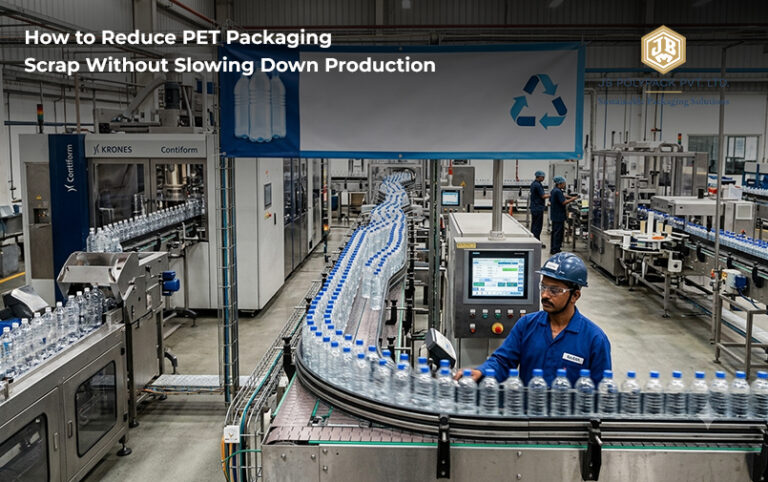
At JB Polypack, we sit on both sides of the PET packaging line. We extrude rigid PET sheet for packaging manufacturers, and we use PET sheet ourselves to thermoform punnets and hinged boxes. That gives us a view of scrap from the extruder through to the trim press, and it has shaped how we think about the problem.
Most PET lines carry two kinds of scrap. The first is designed in: the skeleton web left after parts are punched out, the edge trim on a sheet line, the purge at start-up. The second is process loss: rejected parts, off-gauge sheet, and material lost at every roll change and grade switch. Plants tend to chase the second kind because it looks like a quality problem. The first kind is often larger and quietly accepted as normal.
The usual shortcut is to slow the line until rejects fall. That swaps a material cost for a capacity cost. We approach PET packaging scrap reduction as three separate jobs: make less scrap at source, recover more of what is made, and send the rest somewhere it keeps its value. Below is how we would work through each one.
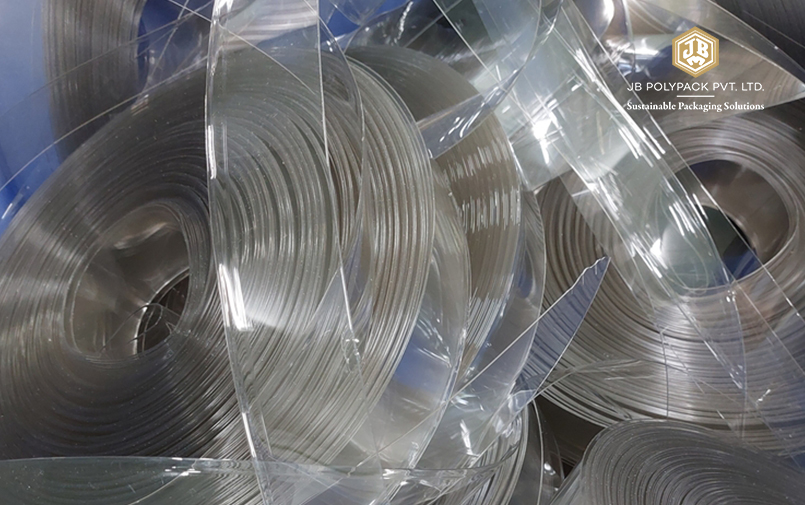
Where PET Packaging Scrap Comes From
Because we run both processes, we find it useful to split scrap by stage.
On a sheet extrusion line
-Edge trim cut from both sides of the web to reach the ordered width
-Start-up and purge material made before gauge and clarity stabilise
-Off-gauge or visually rejected sheet during a run
-Changeover material when moving between thicknesses, widths, or APET and rPET structures
-Roll ends, splices and damaged outer wraps
On a thermoforming line
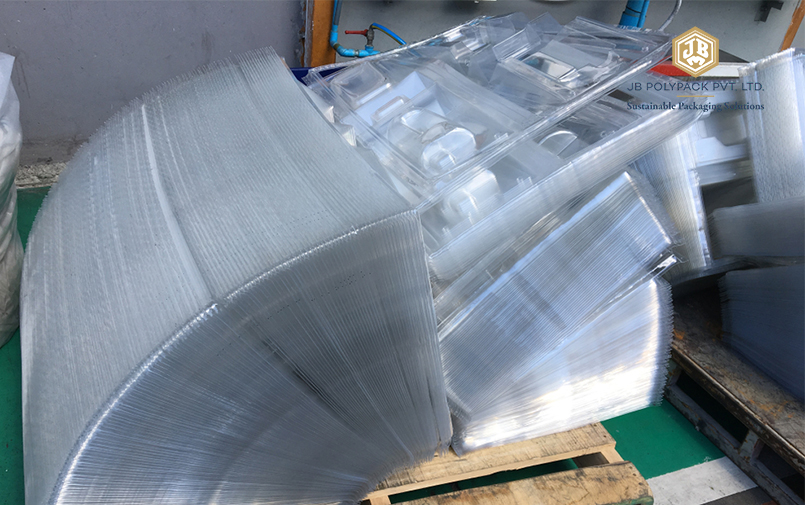
-The skeleton web around formed and trimmed parts
-Extra trim when the sheet is wider than the tool needs
-Start-up parts formed before heater and tool temperatures settle
-Rejected parts: thin corners, haze, poor trim edges, warpage
-Fines and fragments from the trim station
Of these, the skeleton is the one we would look at first. Trade reporting from Plastics Machinery & Manufacturing notes that skeletal waste can account for up to 40 percent of total machine output on thermoforming lines. The actual share on any line depends on part geometry, cavity layout and web width, so it has to be measured on your own line rather than borrowed from a benchmark.
Measure Before You Cut: Building a Scrap Baseline
When a customer tells us they have a scrap problem, our first question is how much scrap, from where. Without that, there is no way to tell whether a change worked. The baseline needs fixed definitions and a fixed period, ideally a full production order or a standard week, since one shift can be skewed by start-up losses.
Two numbers do most of the work:
Material yield (%) = weight of accepted parts ÷ weight of sheet fed to the machine × 100
Scrap rate (%) = weight of all scrap generated ÷ weight of material input × 100
We recommend tracking scrap by category. A single scrap bin hides the cause. A simple set of codes covers most lines:
-Skeleton and edge trim: Weigh it at the granulator or trim collection point. A rise usually points to layout, web width or cavity spacing.
-Start-up and changeover: Weigh it per start-up or changeover event. A rise usually points to recipes, sequencing or warm-up practice.
-Rejected parts: Weigh them at inspection, by defect type. A rise usually points to process stability or the incoming sheet.
-Roll ends and handling damage: Weigh them at roll change and dispatch. A rise usually points to roll specification, storage or handling.
-Contaminated or mixed material: Weigh it at the regrind station. A rise usually points to segregation and housekeeping.
Illustrative example only: a line feeds 1,000 kg of sheet in a week and ships 780 kg of accepted parts. Yield is 78%. If 170 kg of the 220 kg loss is skeleton and 50 kg is rejects and start-up, the skeleton is the bigger lever. A 20% cut in skeleton recovers 34 kg, which is more than the 25 kg gained by halving rejects.
Count rejected parts as scrap even when they are reground, and track regrind recovery as its own figure. Otherwise a plant can report a healthy yield while it forms, rejects and regrinds the same material twice, paying for energy and machine time each round.
Design Decisions That Lock In Thermoforming Material Waste
From the forming side, we have learnt that much of the thermoforming material waste on a job is fixed before the first sheet is heated. Once a tool is cut, the skeleton is largely set. These are the points we would review at the design stage.
Cavity layout and nesting. The gap between cavities, and from cavities to the sheet edge, decides how much web is left behind. Tighter spacing reduces skeleton. Spacing that is too tight can cause webbing, which we cover in our thermoforming troubleshooting guide.
Sheet width matched to the tool. Every millimetre of web beyond what the tool and pin chain need becomes trim. Where volumes justify it, ask your sheet supplier for a width that fits the tool instead of a stock size. As a sheet manufacturer, this is one of the simplest scrap savings we can help a customer make. Our guide to PET sheet technical specifications explains how to specify width, roll format and core size.
Index length. On roll-fed machines, the sheet advanced per cycle sets the gap between rows of parts. Review it whenever a tool is modified, since index settings often carry over from an older layout.
Gauge selection. Thinner sheet means less material per part. Down-gauging only works where the draw still holds minimum wall thickness at the corners and the part survives stacking and transport. Reducing gauge without checking distribution just moves material from the skeleton into the reject bin.
Cost per good part. When customers compare materials or suppliers, we encourage them to look at sheet consumed per good part instead of price per kilogram. Our PET vs PS sheet comparison shows how skeleton share and reject rates feed into that number.
PET Sheet Scrap Management on the Production Floor
Once the design is fixed, scrap is managed through routine. Most of the gains here come from doing the same things the same way every shift.
Start-ups and changeovers
Start-up scrap repeats every time a line starts, so small improvements add up over a year. The practices we would put in place:
-A documented recipe for each part and sheet grade: heater zones, tool temperatures, index length, line speed
-Settings from the last good run recorded and used as the starting point
-A first-off approval so the line moves into production at a defined point
-A production sequence planned to reduce changeovers between thicknesses and structures
Sequencing matters for more than scrap. Where APET and rPET run on the same line, the runs need to be labelled and kept apart for audit and certification, as we explain in our APET vs rPET comparison. Mixed changeover material should stay out of any stream that carries a recycled content or food-contact claim.
Process monitoring
Rejects cost less to prevent than to sort. Monitoring that catches drift early protects yield and line speed together:
-Log rejects by cavity and by defect type, beyond the total count
-Check part weight at set intervals, since weight drift often shows up before a visible defect
-Watch for rejects that begin after a roll change, which points to the incoming sheet
-Include heater elements and thermocouples in planned maintenance
Defect prevention
Webbing, haze from cold crystallisation, corner thinning and warpage each have specific causes and fixes, and we have set those out in our troubleshooting guide. From a scrap point of view, the habit we would stress is changing one variable at a time and letting the line settle. Several changes at once can fix a defect and leave no record of which one worked.
Trim station condition
Worn or badly set trim tooling produces ragged edges, fragments and fines. Fines cause trouble twice. They are hard to recover, and they can contaminate regrind or end up on finished parts. Put trim tool inspection and sharpening on the maintenance schedule, and track fines as a separate category if the volume is noticeable.
Sheet storage and conditioning
PET absorbs moisture from the air. Rolls kept in humid conditions, or moved straight from a cold store to a warm line, can form differently from acclimatised material. We advise keeping rolls wrapped until use and giving them time to reach line conditions before forming.
Regrind: Recovering Scrap Without Compromising Quality
Putting skeleton and trim back into the process is the most direct way to recover value. Our own homepage describes our rigid sheets as made from hot-washed flakes and regrinding waste, so regrind is part of how we work. It also needs discipline, because PET does not forgive careless reprocessing.
Why each melt cycle matters
Every time PET is melted and extruded, some polymer chains break. A 2026 study in the journal Polymers extruded bottle-grade PET up to four times under controlled, dried conditions. Intrinsic viscosity fell from about 0.80 to 0.65 dL/g, elongation at break dropped from about 84% to 60%, and colour darkened with each pass. The authors concluded that PET keeps properties suitable for demanding uses for only a limited number of processing cycles, and noted that moisture uptake would be expected to speed up these changes.
For anyone running regrind, that leads to three rules:
1.Dry it. PET regrind picks up moisture like any PET, and undried regrind degrades faster in the extruder.
2.Hold the ratio steady. A regrind share that swings from batch to batch changes melt behaviour and sheet properties. A fixed, recorded ratio gives the forming line consistent sheet.
3.Limit repeat cycles. Fresh skeleton makes better regrind than material that has already gone round several times.
Keep streams separate
Regrind is only as good as its segregation. The rules we would apply:
-Separate regrind by grade: APET, rPET, and any coloured or coated material
-Keep food-contact and non-food streams apart
-Label bags or bins with grade, source line and date
-Keep granulators clean and screen out metal, labels and floor sweepings
-Send mixed or contaminated regrind to recycling and keep it out of your own sheet feed
Food-contact parts need documentation
India’s rules on recycled PET in food contact have changed recently. The FSSAI Packaging Amendment Regulations, 2025 permit recycled PET for food contact subject to standards and guidelines notified by the food authority. FSSAI’s FCM-rPET guidelines followed on 23 May 2025, and a USDA report hosted by APEDA summarises them as applying to recycling technology approved by FSSAI. These rules are written around recycling post-consumer PET. How in-house regrind should be documented for food-contact parts is something to settle with your compliance advisers and your sheet supplier before regrind goes into a food-contact product.
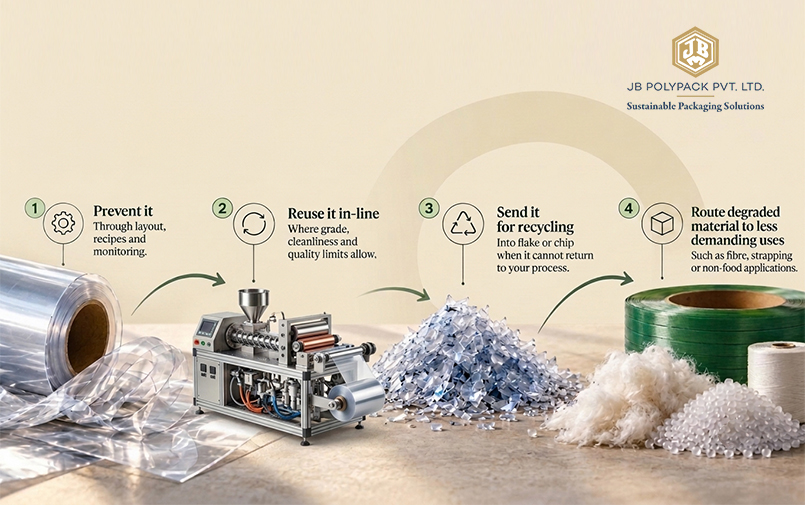
Can PET Sheet Waste Be Recycled? Routes for What You Cannot Reuse
Yes. Clean, segregated PET sheet waste is recyclable, and recovered PET is the starting point for much of what our group makes. Not every scrap stream should go back into your own sheet, though. The order of priority we follow in thinking about scrap:
1.Prevent it through layout, recipes and monitoring
2.Reuse it in-line where grade, cleanliness and quality limits allow
3.Send it for recycling into flake or chip when it cannot return to your process
4.Route degraded material to less demanding uses such as fibre, strapping or non-food applications, in line with the Polymers study’s findings on repeatedly processed PET
At stages 3 and 4, value depends on handling. Clean, dry, single-grade scrap is worth more to a recycler than mixed bales with labels, fines and floor dirt. Our article on PET flakes in the circular economy explains how recovered PET moves back into production. Our sustainability page describes how we make rigid sheet from hot-washed flakes produced from waste PET bottles. Our PET straps use green flakes and strap waste as inputs, and we also supply recycled PET chips for industrial and textile uses.
Compliance and claims
Scrap handling now sits next to regulatory obligations. The Plastic Waste Management (Amendment) Rules, 2026, notified as G.S.R. 237(E) on 31 March 2026, set mandatory recycled content for Category I plastic packaging at 30% for 2025-26, rising to 60% from 2028-29. The same amendment requires recycled plastic packaging to conform to IS 14534:2023, the BIS guideline on recovery and recycling of plastics waste, and to carry recycled content labelling.
We also advise care with wording. In-house regrind reduces material consumption. Describing it as recycled content is a separate question with its own rules. For exporters to the United States, the Federal Trade Commission’s Green Guides at 16 CFR 260.13 treat a recycled content claim as deceptive where the material is scrap normally reused within the original manufacturing process. Keep scrap reduction and recycled content as separate lines in sustainability reporting, each backed by its own records.
Protecting Throughput: Plastic Packaging Production Efficiency
The point of PET manufacturing waste reduction is more good parts per hour from the same sheet. If scrap falls because output falls, nothing has been gained. These are the principles we would use to keep both in view.
Track good parts per hour alongside yield. If yield rises while good output per hour falls, the improvement is probably a slowdown in disguise.
Find the cause before reducing speed. A slower line can hide a heating imbalance, a worn trim tool or a gauge issue in the incoming sheet. Find the cause first, then decide whether speed is really the limit.
Make regrind handling continuous. In-line granulation and a steady return ratio avoid storage, double handling and the swings that come with large, occasional regrind additions.
Cut changeover time and changeover scrap together. Recipes and first-off approval shorten the time a line runs without making saleable parts, which helps both measures.
Give operators the numbers. Shift-level scrap by category, shown at the line, turns scrap from a monthly accounts figure into something operators can act on during the shift.
A 30-Day Plan to Start Reducing Scrap
For a plant with no formal tracking, this is the four-week sequence we would suggest:
-Week 1: Set up scrap categories and weigh each one per shift. Record line speed and good parts per hour alongside.
-Week 2: Calculate yield and scrap rate by category. Find the single largest category by weight.
-Week 3: Make one change aimed at that category, such as a revised start-up recipe, a width review with your sheet supplier, or regrind segregation.
-Week 4: Compare against the baseline on yield and output per hour. Keep the change if both hold, then move to the next category.
Frequently Asked Questions
How can PET packaging scrap be reduced?
PET packaging scrap is reduced by measuring scrap by source and acting on the largest category first. Typical actions include tighter cavity layouts, sheet width matched to the tool, documented start-up recipes, fewer changeovers, early detection of process drift, and controlled in-line regrind. Each change should be checked against output per hour so the reduction does not come from slowing the line.
What causes excessive scrap in PET thermoforming?
Excessive scrap in PET thermoforming usually comes from a large skeleton web caused by layout or oversized sheet width, repeated start-up and changeover losses, and rejects caused by uneven heating, moisture, trim tool wear or gauge variation in the incoming sheet. PET’s narrow forming window means small process drifts can turn into rejects quickly.
Can PET sheet waste be recycled?
Yes. Clean PET sheet waste can be reground and returned to production where grade and quality limits allow, or sent for recycling into flake or chip. Segregating scrap by grade, keeping it dry and free of labels and dirt, and keeping food-contact streams separate all raise its value. Material that has been reprocessed several times suits less demanding uses.
How can manufacturers improve PET material utilization?
Manufacturers improve PET material utilization by tracking material yield (accepted part weight divided by sheet input), reducing designed-in skeleton through layout and width choices, using the thinnest gauge that still meets wall thickness and strength needs, and returning clean, dried regrind at a consistent ratio. Comparing options on sheet consumed per good part gives a clearer picture than price per kilogram.
Share Your Scrap Data With Us
Many scrap savings start with the sheet: width matched to the tool, consistent gauge across the web, and clear information on what each roll contains. If your baseline points to sheet-related losses, send us your part drawing, tool layout, current sheet specification and scrap breakdown. We will review which rigid PET sheet options suit your line and share the data available for your grade. Contact our team to start the conversation.