PET Sheet Thermoforming Troubleshooting: Fixing Webbing, Defects and Forming Problems
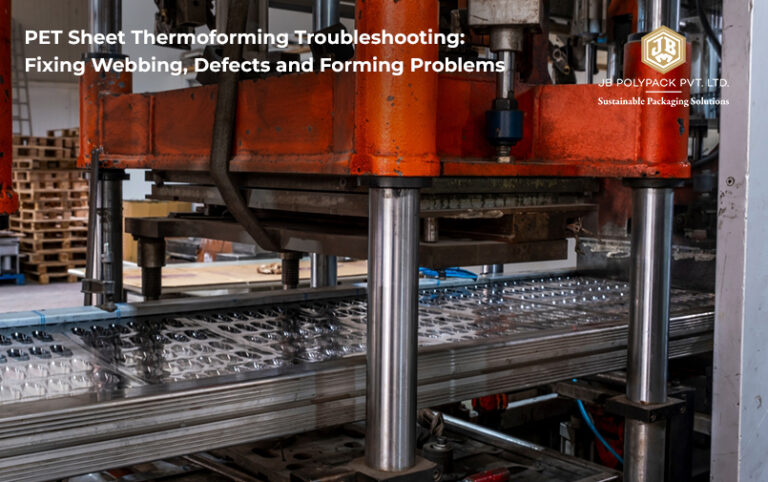
A thermoforming defect is a diagnostic signal before it is a scrap cost. Where the fault appears on the part, and whether it repeats in the same position across every cavity, narrows the cause considerably before anyone adjusts a setting.
Most line troubleshooting goes wrong in the same way. An operator sees webbing, reaches for the oven controls, and starts chasing the symptom through the one variable that is easiest to change. Temperature is often involved. It is rarely the only thing involved, and on PET it behaves in ways that other sheet materials do not.
What follows works through the common failures in PET thermoforming, the mechanisms behind them, and the order in which to test for causes.
Start by Locating the Fault
Every defect on a thermoformed part originates in one of three places: the sheet arriving at the machine, the tool, or the process running between them.
Separating these before adjusting anything saves considerable time, because the diagnostic questions are different in each case:
– If the defect repeats identically in every cavity and every cycle, look at the tool and the process, since sheet variation would not produce that consistency.
– If the defect appears in some cavities and not others, look at heating uniformity across the web, tool temperature variation, and vacuum distribution.
– If the defect came on gradually, or arrived with a new roll, look at the sheet before touching a machine setting.
– If it appeared after a material change or a regrind ratio change, treat the sheet as the primary suspect regardless of how the defect looks.
Published work on APET thermoformability notes that extruded sheet can vary in resin microstructure, contamination, regrind content, thickness, thermal history, crystallinity, and residual stress, and that these variations show up in production as non-uniform heating, wall thinning, tearing, haze, pin holes, shape distortion, and difficult demoulding. That is a wide span of symptoms from a single upstream category, and it is the reason sheet should be ruled in or out early rather than last.
Webbing
Thermoforming webbing is excess material folding on itself, most often at corners, between cavities, and at geometry transitions. The material has nowhere to go as the sheet draws down, so it gathers.
The common causes and the corresponding adjustments:
– Sheet too hot. Over-softened material stretches inconsistently and gathers rather than drawing evenly. Reducing the heating cycle is frequently the whole fix.
– Excess material in the affected area. Where cavity spacing leaves more sheet than the draw can absorb, the material folds. Take-up blocks or pushers can manage the excess, though this becomes difficult where the webbing falls on a visible surface.
– Draw too deep for the geometry. Deeper draws increase the tendency toward wrinkling, and correcting this usually means tool changes rather than process changes.
– Cooling tube height set incorrectly. Plastics Business reports that cooling tubes set too high allow material to lift off the pin chain and fold over, producing rippling in the sheet. The standard guidance given is material thickness plus roughly 0.5mm to 0.75mm, with the caveat that on thinner materials this clearance is too generous and the tubes should instead be set using a double layer of material. Set too low, the same tubes create drag and generate dust.
That last point is worth checking early on roll-fed lines, because it is a machine setup issue that presents as a material problem and survives any amount of oven adjustment.
The PET-Specific Trap: Cold Crystallization
This is where PET sheet departs from the materials most operators learn on, and where a general troubleshooting habit will make the part worse.
With amorphous materials such as polystyrene, softening begins at the glass transition temperature and forming works across a broad window above it. PET does not behave that way. According to ScienceDirect’s overview of gauge thermoforming, the maximum forming temperature for aPET is restricted to around 120°C, because above that point the polymer reverts toward the crystalline form through cold crystallization.
The practical consequences on the line:
– Haze, whitening, or milky patches on a normally clear part often indicate localised crystallisation rather than a contamination or clarity problem in the sheet.
– Parts that turn brittle at corners after forming may have crystallised in the most heavily worked areas.
– Adding heat to fix a forming defect can cross the ceiling and introduce a second, worse defect on top of the first.
The forming window on PET is narrower than on the amorphous materials operators are used to, so the correct response to a suspected heat problem is smaller increments and zone-level control rather than a global oven increase. Where haze is appearing in specific positions, uneven heating across the web is the more likely explanation than the overall setpoint.
Wall Thinning and Corner Failure
Thinning at corners, split corners, and parts failing a minimum wall specification at a single point are all the same underlying problem, which is material distribution during the draw.
Sheet temperature is the dominant variable. The machine builder GABLER notes that a sheet that is too cold stretches unevenly and may tear at stress points, while a sheet that is too hot becomes overly fluid, sags, and distributes unpredictably.
Beyond temperature, distribution is governed by the plug. Research published in Polymer Engineering and Science found that plug design plays a crucial role in controlling wall thickness distribution, with specific findings that matter on a production floor:
– Larger plugs push more material toward the base of the part, at the expense of the walls.
– A small sidewall taper, a base radius, or a reduction in plug diameter each tend to produce a more balanced distribution.
– Large changes to any of these variables tend to destroy the benefit rather than increase it, so adjustments should be incremental.
– Frictional and thermal properties of the plug material influence how the sheet deforms, and there is clear evidence of the sheet slipping during plug contact.
A related study identified plug displacement, sheet temperature, plug temperature, and plug shape as the parameters with the greatest measured effect on wall thickness distribution. Plug temperature is frequently overlooked because it is not adjustable on many machines, though it changes the friction between plug and sheet and therefore changes how much material the plug carries with it.
Surface Defects and Distortion
Several surface problems are commonly misattributed, and each has a fairly specific mechanism.
– Pin holes and blistering point toward moisture. PET is hygroscopic, and moisture that entered the material before or during extrusion produces surface pitting and voids rather than a forming fault.
– Mark-off and chill marks occur where the mould surface is too cold at contact, or where imperfections in the mould surface transfer to the part.
– Whitening and stress marks along draw lines generally indicate forming below the optimum temperature, or over-stretching in that zone, and should be distinguished from the crystallisation haze described above. Stress whitening follows the direction of the draw. Crystallisation haze tends to sit where the sheet was hottest.
– Warpage after demoulding results from residual stress relaxing. Research on plug-assisted thermoforming attributes warpage to the relaxation of residual stresses carried over from the processing history of the sheet, principally extrusion or calendering, which means it is partly inherited rather than wholly created at the forming station.
When the Sheet Is the Variable
We manufacture PET sheet, so we see the sheet-side causes more often than most, and we would rather a customer identifies one quickly than spends a week on the oven.
Sheet characteristics that change forming behaviour without any machine setting having moved:
– Gauge tolerance across the web. Thickness variation produces uneven heating, since thicker sections absorb heat at a different rate, and the result presents as inconsistent draw across the part.
– Regrind ratio. A change in regrind content alters thermal behaviour and can alter clarity, and it is a common cause of a defect appearing between two lots of nominally identical sheet.
– Contamination. Particulate contamination can act as a nucleating site, which on clear PET produces localised haze in an otherwise transparent part.
– Thermal history and residual stress. Sheet carries stress from extrusion, and that stress relaxes during heating and after forming.
Sheet conditioning and storage. Material brought straight from a cold store or a humid yard to a running line does not behave like material that has acclimatised.
The diagnostic that isolates this quickly is to run a retained roll from a lot that formed correctly, with every machine setting unchanged. If the defect disappears, the sheet is the variable and no amount of process adjustment will hold the correction.
A Working Sequence
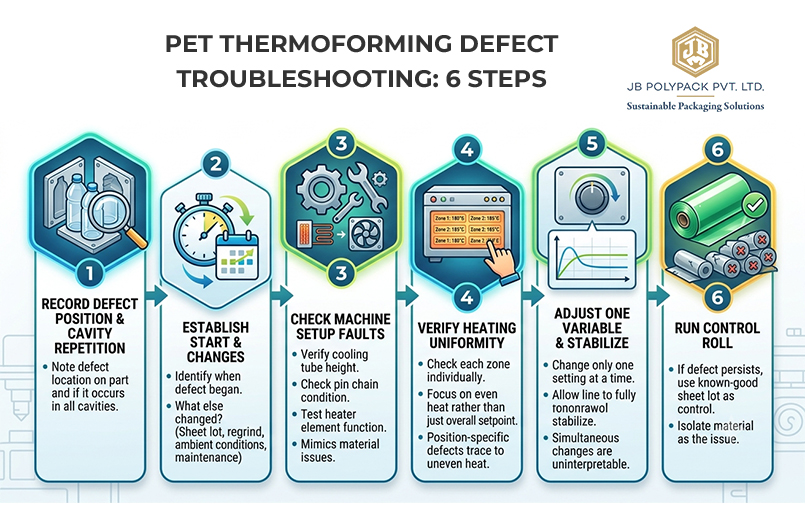
When a defect appears on a running line, the order of investigation matters more than the individual checks:
– Record the defect position on the part and whether it repeats across all cavities before changing anything.
– Establish when it started, and what else changed at that point, including sheet lot, regrind, ambient conditions, and any maintenance.
– Check machine setup items that mimic material faults, particularly cooling tube height, pin chain condition, and heater element function.
– Verify heating uniformity zone by zone rather than adjusting the overall setpoint, since the majority of position-specific defects on PET trace to uneven heat rather than incorrect average heat.
– Adjust one variable at a time and allow the line to stabilise, because thermoforming parameters interact and simultaneous changes make the result uninterpretable.
– If the defect survives all of the above, run a control roll from a known-good lot.
Frequently Asked Questions
What causes webbing in thermoforming, and what is the first thing to check?
Webbing is excess material folding where the draw cannot absorb it. Sheet temperature and cavity spacing are the usual causes, though on roll-fed lines cooling tube height is worth checking first, since incorrect settings allow material to lift off the pin chain and fold over in a way that looks like a heating fault.
Why do PET parts turn hazy or white during forming?
Two different mechanisms produce whitening. Crystallisation haze occurs when PET exceeds its forming ceiling, since the polymer moves toward the crystalline form above roughly 120°C. Stress whitening occurs at the opposite end, when forming happens below optimum temperature or the material is over-stretched. Where the whitening sits on the part usually distinguishes them.
Is PET harder to thermoform than other sheet materials?
It has a narrower usable forming window than amorphous materials such as polystyrene, which form across a broad temperature range above their glass transition. PET requires closer temperature control and benefits from zone heating, and adding heat to solve a forming problem carries a risk that does not exist with wider-window materials.
My parts are thinning at the corners. Do I need thicker sheet?
Not usually. Corner thinning is a distribution problem rather than a starting gauge problem, and published research points to plug displacement, plug shape, plug temperature, and sheet temperature as the parameters with the greatest effect on where material ends up. Increasing gauge raises cost without necessarily improving the thin point.
What causes warpage after the part leaves the mould?
Residual stress relaxing. Some of that stress is created at the forming station through uneven cooling or premature demoulding, and some is inherited from the sheet’s extrusion history. If warpage appears with a new lot at unchanged settings, the inherited component is the more likely source.
How do I tell whether a defect is coming from the sheet or the machine?
Run a retained roll from a lot that formed correctly, with no settings changed. It is the fastest test available and it removes the ambiguity that otherwise drives days of process adjustment.
Should I ask my PET sheet supplier for forming parameters?
Ask for the characteristics that drive forming behaviour rather than a recommended setpoint, since the correct setpoint depends on your tooling, line speed, and draw ratio. Gauge tolerance, regrind content, and lot-to-lot consistency data are more useful to a process engineer than a temperature figure.
If you are working through a recurring forming defect and want a second view on whether the sheet is contributing, send us the details along with a retained sample and we will look at it with you.
JB Polypack Pvt. Ltd. manufactures rigid PET sheets, thermoformed PET packaging, and PET straps from Surat as part of the Jay Bharat Group.