PET Sheet vs PS Sheet: A Practical Guide for Packaging Manufacturers
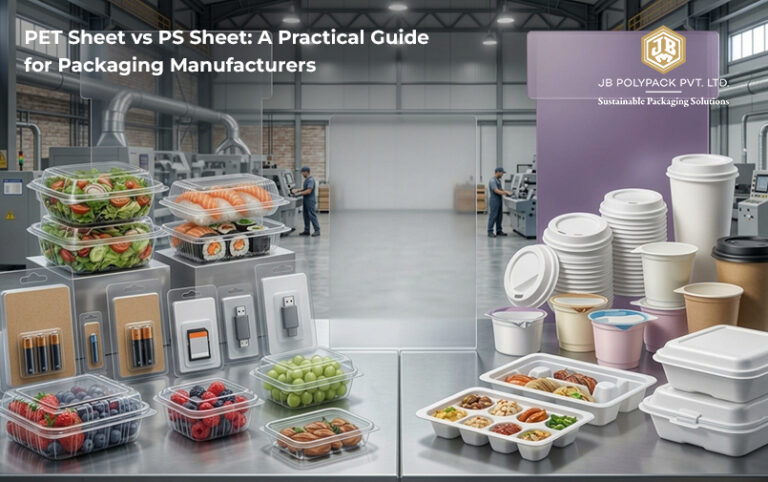
Most converters in India who run polystyrene today did not pick it after a head-to-head trial. They inherited it. PS sheet was the clear, cheap, easy-forming default for cups, lids, trays and blister bases for a long time, and a lot of forming lines were set up around it.
The question now coming from brand owners and procurement teams is a narrower one. Should this particular part be PET instead?
The honest answer depends on four things: what the part has to hold, what abuse it has to survive, which regulations touch the product inside it, and what the sheet really costs per finished part. That last number is rarely the price per kilogram on a quotation. The sections below work through the PET sheet vs PS sheet decision on each of these points, with a named source for every material property quoted, and finish with a checklist a production or purchase team can run before committing a tool.
What Sits Under Each Label
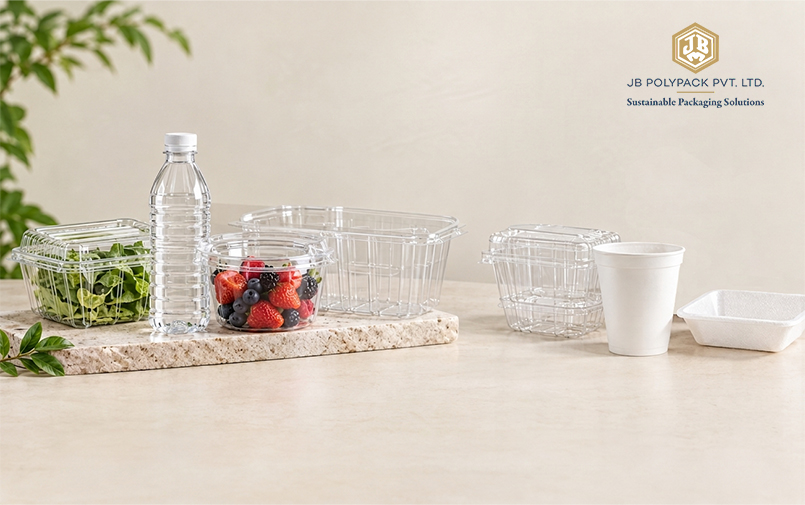
“PET vs PS” sounds like a comparison between two materials. In practice each label covers a small family of grades, and mixing them up is where a lot of bad specifications start. Before comparing anything, pin down which PET sheet material and which PS grade are actually on the table.
On the PET side:
– APET (amorphous PET) is the standard PET thermoforming sheet. It is extruded and cooled quickly so the polymer stays amorphous and clear.
– rPET is PET sheet with recycled content. For food applications it is commonly built as a three-layer structure with a recycled core between virgin skins, which is how JB Polypack’s PET sheet range describes its RPET construction. The trade-offs between the two are covered separately in our comparison of APET and rPET sheets.
– CPET is deliberately crystallised PET for ovenable trays. It rarely competes with PS and sits outside this comparison.
– PETG is a different polymer altogether, and it gets its own section below.
On the PS side:
– GPPS (general purpose polystyrene) is the clear grade. SpecialChem describes it as a clear, brittle thermoplastic with low moisture absorption and low cost.
– HIPS (high impact polystyrene) is rubber-modified PS. The rubber phase improves toughness and resistance to stress cracking, and according to the ILSI Europe report on polystyrene for food packaging, certain HIPS types are less sensitive to stress cracking than general grades. The price of that toughness is clarity. HIPS is normally opaque.
– EPS (expanded polystyrene foam) is thermocol. It is a separate product category and is left out here, apart from one regulatory point further down.
So the real comparison for a clear part is usually APET or rPET against GPPS. For an opaque part it is PET against HIPS. Those are two different conversations.
PET G Sheet and Polyethylene Terephthalate Glycol Sheet: A Separate Material
Buyers often search for “PET G sheet” or “polyethylene terephthalate glycol sheet” as though it were another name for PET sheet. It is a copolyester with its own chemistry.
A peer-reviewed review published on PubMed Central explains that glycol-modified PET contains a significant share of CHDM (cyclohexanedimethanol), a bulkier building block that replaces part of the ethylene glycol in the polymer chain. SpecialChem’s guide to PET and PETG adds that the modification lowers the glass transition and melting temperatures and slows the rate of crystallisation.
What that means on a forming line:
– PETG resists the heat-induced haze that limits how hard APET can be pushed in the oven.
– It is widely used in thicker gauges for displays, guards and medical parts where easy forming and clarity matter.
– A specification that says “PETG” and one that says “PET” describe different materials with different grade documentation.
If a drawing or a tender says PETG, confirm with the person who wrote it whether they mean PETG itself or simply clear PET sheet. The answer changes who can quote and what the sheet will cost.
Price per Kilogram Is the Wrong First Comparison
Sheet is bought by weight and sold to your customer by the piece. The two materials do not weigh the same.
Reference data from NETZSCH, the thermal analysis instrument maker, shows PET to be a noticeably denser polymer than polystyrene. Density is what turns a price per kilogram into a price per square metre of sheet.
At the same gauge and the same formed area, a PET plastic sheet puts more material into every part than a PS sheet does. A PET quotation that looks close to a PS quotation per kilogram can therefore come out meaningfully higher per part. Comparing the two on the quotation alone, with no conversion to area, is one of the most common costing mistakes in a PET vs PS evaluation.
Everything else rarely stays equal, which is why the number needs checking against your own part:
– Gauge. If a tougher material lets you run a thinner sheet for the same drop or stacking performance, the weight gap narrows. Whether it does for your geometry is a question for a trial. It cannot be settled on paper.
– Scrap and skeleton. The share of sheet that ends up as trim depends on nesting and cavity layout. It applies to both materials, and it multiplies whatever price difference exists.
– Rejects. A cheaper sheet that cracks during trimming, stacking or transport costs more per good part than its invoice suggests.
A practical formula for comparing quotes is: price per kg × density × thickness × sheet area consumed per cycle ÷ good parts per cycle. Put both materials through it with real numbers from your line before looking at anything else.
Which Is Stronger: PET or PS?
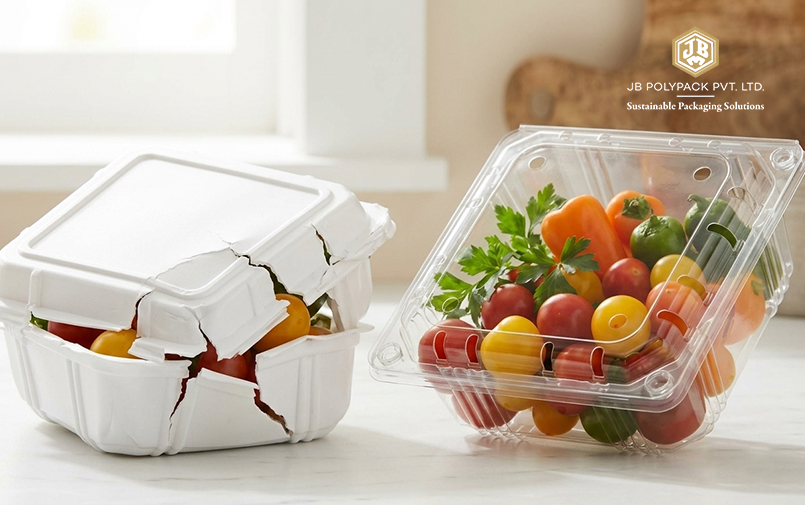
For clear packaging, PET is the tougher material. The distinction that matters is between stiffness and toughness.
GPPS is stiff. It holds its shape well and feels rigid in the hand. What it lacks is resistance to cracking under impact or flexing. Gabler, the German thermoforming machine builder, notes in its guidance on brittle parts that polystyrene is naturally more brittle than polypropylene or PET.
PET behaves differently. SpecialChem describes it as practically shatter-resistant, with good impact resistance and dimensional stability, which is why it is used as a glass replacement in some applications.
HIPS closes much of the toughness gap with PET. It does so by adding rubber, and the rubber scatters light. That leaves a clear choice for any part where the customer needs to see the product:
– GPPS: clear and stiff, and prone to cracking.
– HIPS: tough, and opaque.
– APET or rPET: clear and tough.
Where does brittleness show up in practice? Snap-fit lids that are opened and closed repeatedly. Thin corners at the bottom of deep draws. Stacks that shift in a truck. Trimming, where a brittle skeleton can shed fragments. Any part that does one of these things regularly deserves a hard look at whether GPPS is the right sheet.
What the Part Holds Matters More Than Most Specs Admit
A thermoformed part lives most of its life in contact with a product. That product can decide the material before cost or appearance enter the discussion.
Fats, oils and organic liquids. The ILSI Europe report states that polystyrene is susceptible to stress cracking by organic liquids and oils, which limits its use with foods high in fats and vegetable oils. SpecialChem lists PET as having excellent resistance to alcohols, oils, grease and aliphatic hydrocarbons. For namkeen, fried snacks, oily confectionery, dressings, or cosmetics with oil-based formulations, this one property often settles the PET vs PS question.
Moisture and gases. The same ILSI report notes that polystyrene and HIPS have poor barrier properties to water vapour and gases. PET, per SpecialChem, has good gas and moisture barrier properties. How barrier translates into product protection over a supply chain is covered in our piece on plastic packaging and food damage.
Heat. This is where the usual “PET is better” story needs a correction. Every rigid plastic has a glass transition temperature, the point at which it moves from hard and glassy towards soft and rubbery. Reference data from SpecialChem and NETZSCH places this point lower for amorphous PET than for polystyrene. In plain terms, APET begins to soften at a lower temperature than PS. Neither APET nor GPPS is suitable for hot fill or oven use, and anyone specifying APET for a warm-fill application should test the filled part at the real fill temperature. Genuine heat resistance in PET comes from CPET, which is a different sheet for a different job.
PET Sheet for Thermoforming vs PS: What Changes on the Line
Converters who have spent years forming PS usually find that PET sheet thermoforming needs a different mindset, especially around heat.
PS forms forgivingly. NETZSCH notes that commercial amorphous polystyrene is atactic, meaning it does not crystallise in normal processing. Above its glass transition it softens progressively, and the forming window is governed mainly by sag, detail and cycle time.
PET has a ceiling. SpecialChem explains that PET begins to crystallise once it is heated a little way past its glass transition, and the rate of crystallisation climbs as the temperature rises further. On a thermoforming line, sheet that is overheated or held too long in the oven begins to crystallise, and crystallised PET loses clarity and toughness. The practical consequence is a narrower process window than PS, where more heat is not always the fix for poor definition.
Moisture handling differs. SpecialChem notes that PS has low moisture absorption. Gabler points out that PET is hygroscopic, and that when moisture-laden hygroscopic material is heated, the water can degrade the polymer and increase brittleness. Keeping PET rolls wrapped and stored sensibly until they reach the machine is cheap insurance.
Switching a line is a project. Heater profiles, cycle times, tool temperatures and plug assist settings developed for PS will need retuning for a PET thermoforming sheet. Whether existing tooling transfers depends on shrinkage, draw ratio and the tool design itself, and that is a conversation to have with the toolmaker before promising a customer a changeover date. Plan for trial runs with sheet from the supplier you intend to use in production, since sheet consistency affects how stable the process is once it is running. For a general refresher on vacuum and pressure forming, see our overview of thermoforming basics.
The Regulatory Picture in India
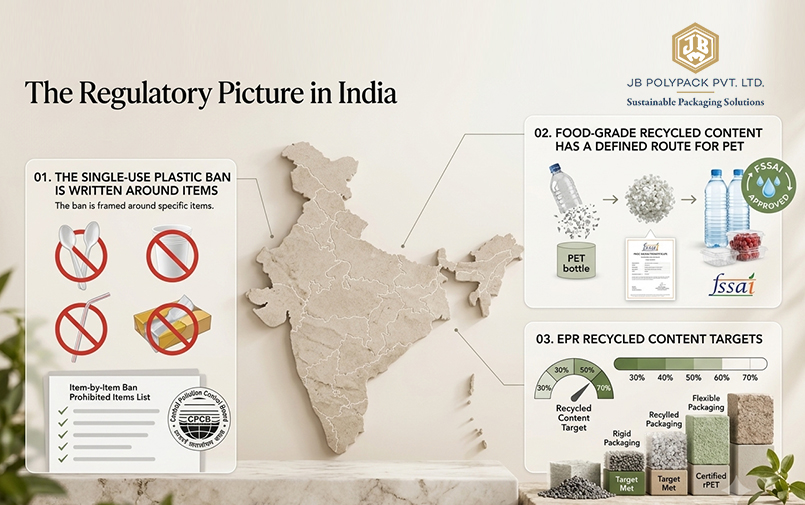
Two regulatory points bear directly on the PET vs PS decision for Indian converters. A third is covered in detail elsewhere.
The single-use plastic ban is written around items. The Central Pollution Control Board’s press release on the SUP ban lists the prohibited items, including polystyrene (thermocol) for decoration, and plates, cups, glasses, cutlery, straws, trays and packing films around sweet boxes. The list names products. Moving a listed item from PS to PET does not take it off the list. Before quoting on a disposable format, check it against the notified items first and the material second.
Food-grade recycled content has a defined route for PET. SGS reports that the FSSAI’s Packaging First Amendment Regulations, 2025 permit products made of recycled PET for packaging, storing, carrying or dispensing food, subject to the standards and guidelines notified by the food authority. The amendment names recycled PET specifically. For a brand owner who needs recycled content in rigid food-contact packaging, that is a documented pathway, and it runs through PET.
EPR recycled content targets apply to rigid plastic packaging and increasingly shape what brand owners ask their converters for. The obligations and how certified rPET sheet helps meet them are explained in the APET vs rPET comparison, so they are not repeated here.
Where PS Sheet Still Makes Sense
A guide written by a PET sheet manufacturer should say this plainly: PS remains a reasonable choice for some parts.
– Opaque parts where cost per part rules. HIPS is tough, forms easily and is light. If the customer does not need to see the product, the clarity advantage of PET disappears from the equation.
– Dry, low-fat products in formats outside the SUP list, where the part is not flexed, dropped or stacked heavily, and the buyer is not asking for recycled content.
– Lines with no budget to requalify. If a PS part is running cleanly, passing its customer’s tests and facing no regulatory or buyer pressure, a switch has to be justified by something concrete. “PET is more modern” is not a reason to retool.
The picture changes quickly when any of the following appear: oily or fatty contents, a requirement for clarity and toughness together, a customer asking for recycled content in food contact, or a format under regulatory scrutiny.
A Decision Checklist Before You Commit a Tool
Run each new or reviewed part through these questions. Two or more answers pointing towards PET is usually enough to justify a sampling trial.
1. Does the customer need to see the product? If yes, the choice narrows to GPPS or PET.
2. Does the part get flexed, snapped, dropped or stacked under load? If yes, GPPS is the weak option.
3. Does the product contain fats, oils or organic solvents? If yes, the ILSI guidance on PS stress cracking applies.
4. Is the part filled warm or exposed to heat? If yes, test APET and PS at the real temperature, and consider whether CPET is the correct answer.
5. Is the format on the SUP list? If yes, changing polymer will not help.
6. Is the brand owner asking for recycled content in food contact? If yes, recycled PET has the defined FSSAI route.
7. What is the cost per good part? Use density, gauge, trim and reject rates, and ignore price per kilogram on its own.
Sourcing PET Sheet for the Trial
JB Polypack, part of the Jay Bharat Group in Surat, manufactures rigid PET sheet in APET and RPET variants for thermoforming, alongside thermoformed PET punnets and hinged boxes. If you are evaluating a move from PS, send us the part drawing, your current gauge, your machine type and the product the part will hold. Grade-specific data and sample sheet for trials can be arranged on request.
Frequently Asked Questions
How to choose between PET and PS sheet?
Start with what the part holds and how it is handled. Choose PET when the part needs clarity and toughness together, contains oily or fatty products, or needs food-contact recycled content. PS can still suit dry, low-stress, cost-driven parts, with HIPS for opaque formats. Compare cost per finished part, since PET’s higher density makes price per kilogram misleading.
PET sheet vs PS sheet for thermoforming: which is easier to run?
PS is generally more forgiving on a thermoforming line. Commercial PS is amorphous and does not crystallise during forming, so it softens progressively with heat. PET crystallises if overheated, which reduces clarity and toughness, so its usable temperature window is narrower. PET also absorbs moisture, which makes storage and handling more important.
Which is stronger, PET or PS?
PET is tougher than clear polystyrene. GPPS is stiff but brittle and cracks under impact or repeated flexing. PET is described by SpecialChem as practically shatter-resistant. HIPS matches much of PET’s toughness through rubber modification, but it loses clarity in the process and is normally opaque.
Is PETG sheet the same as PET sheet?
No. PETG is a glycol-modified copolyester that contains CHDM in place of part of the ethylene glycol. The modification slows crystallisation and lowers its softening temperatures, which makes it easy to form and resistant to haze. Standard PET thermoforming sheet is APET or rPET. Always confirm which material a specification means.
Does PET sheet cost more than PS sheet?
Per kilogram, the answer depends on market prices at the time of purchase. Per part, PET carries a structural disadvantage because it is a denser polymer, so a PET sheet of the same gauge contains more material than a PS sheet. Gauge reduction, lower rejects and buyer requirements can offset that, and a line trial is the only reliable way to know for a specific part.