APET vs rPET Sheets: Key Differences & Benefits
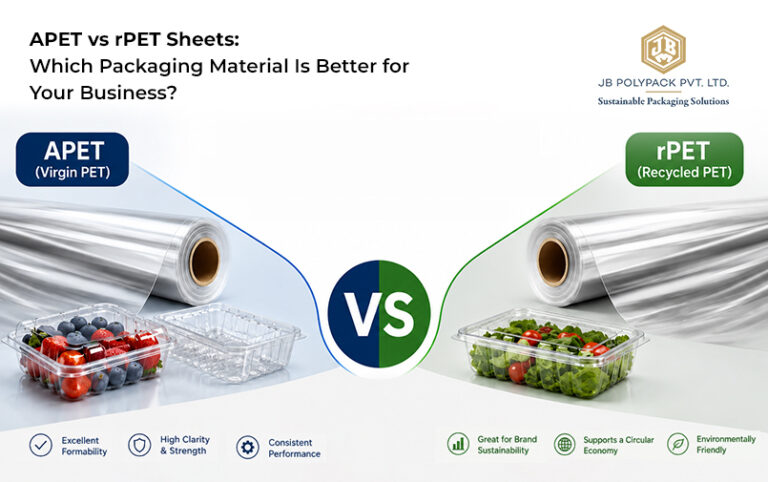
APET vs rPET Sheets: Which Packaging Material Is Better for Your Business?
When procurement teams source rigid PET sheets for thermoforming applications, the choice between APET and rPET sheets often collapses into a price conversation. That framing misses the actual decision. The choice turns on application requirements, regulatory position, thermoforming line specifications, and, increasingly in India, EPR compliance obligations that directly affect procurement eligibility with major buyers.
APET and rPET share the same base polymer: Polyethylene Terephthalate. What differs is how each material is produced, what that production history does to its optical and mechanical properties, and which applications each variant serves reliably. A buyer who understands those distinctions can specify the correct grade from the outset, avoid costly mid-run substitutions, and align material selection with India’s evolving recycled content mandates. These mandates are already active and already affecting supplier qualification criteria across FMCG, retail, and export supply chains.
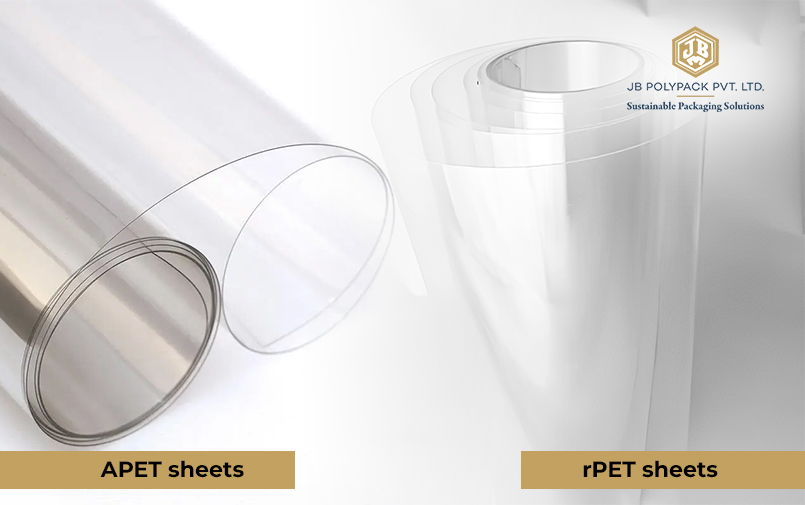
What APET Sheets Actually Are
APET stands for Amorphous Polyethylene Terephthalate. The “amorphous” refers to its molecular structure. During extrusion into sheet form, the PET is cooled rapidly, which prevents the polymer chains from organising into a crystalline lattice. The result is a sheet that remains optically clear because crystalline zones scatter light; in APET, those zones are largely absent.
This is materially different from CPET (Crystalline PET), which is deliberately crystallised for dual-ovenable food trays, where opacity is a processing outcome. APET is the opposite: transparency is engineered into the manufacturing protocol.
Key physical properties of APET sheets include exceptional optical clarity with very low haze in well-extruded commercial grades, strong dimensional stability during thermoforming, and resistance to oils, greases, and many solvents relevant to food-contact and pharmaceutical applications. APET is free of plasticisers and chlorine, which is a specific advantage over PVC in applications requiring food certification. All figures below reflect general industry parameters for commercial-grade PET sheet. JB Polypack provides grade-specific test reports on request for any application.
APET is manufactured from virgin PET resin, or from industrial regrind that meets strict quality and contamination thresholds. The molecular weight of the feedstock determines mechanical performance across the formed part. Degraded feedstock produces brittle formed parts and surface inconsistencies that create problems downstream in printing and sealing lines.
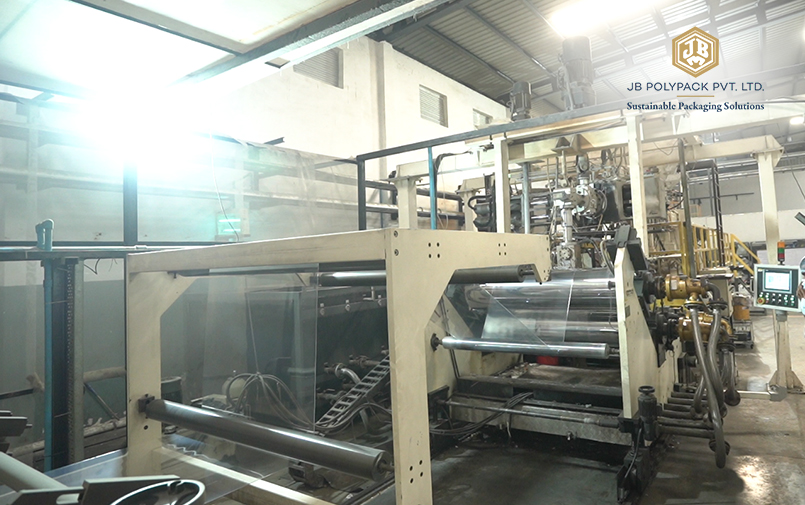
Rigid PET sheets from JB Polypack are produced on twin-screw extruder systems that maintain melt homogeneity and control processing temperatures precisely, both critical to achieving consistent clarity across roll widths.
What rPET Sheets Are: The Quality Case Beyond the Sustainability Claim
rPET (Recycled PET) sheets are produced using post-consumer or post-industrial recycled PET as feedstock, typically sourced from hot-washed PET bottle flakes collected, sorted, caustic-washed, and pelletised before re-extrusion into sheet.
For years, rPET carried a perception problem in procurement conversations: the assumption that recycled content automatically meant compromised optical performance or inconsistent mechanical properties. That perception is now outdated, and the certification infrastructure that replaced it is the reason.
How Certifications Have Changed the rPET Quality Conversation
The quality of an rPET sheet is determined by the discipline of the upstream collection, sorting, washing, and extrusion process. When that process is certified and audited, buyers get independently verified assurance of what they are purchasing rather than relying on a supplier’s word.
GRS (Global Recycled Standard) certifies the full chain of custody from post-consumer material collection through to the finished sheet. A GRS-certified rPET sheet means the recycled content claim has been verified at every production stage. This is the document buyers need for CPCB EPR compliance reporting on recycled content use, and increasingly it is a vendor qualification requirement among major retail and FMCG buyers.
FSSAI conditional approval for food-grade rPET covers rPET sheets used in food-contact thermoformed packaging, with specific requirements on decontamination validation, source traceability, and migration limits for acetaldehyde and other volatiles. rPET sheets used in direct food-contact applications must come from manufacturers whose process has been validated under these criteria. This approval pathway exists because the safety case for food-grade rPET has been established; it is a controlled and documented process, not a workaround.
The three-layer co-extruded structure is the standard construction for food-contact rPET sheets: a recycled PET core between thin virgin PET skin layers. The virgin skin layers maintain surface quality including gloss, optical clarity, and printability, while functioning as a barrier between the recycled core and the food contact surface. This construction is how food-grade rPET delivers on both recycled content targets and food safety requirements simultaneously.
The Jay Bharat Group, the parent of JB Polypack, operates an integrated supply chain that includes rPET chip manufacturing from post-consumer feedstock, giving buyers access to controlled recycled material at the resin level before sheet extrusion begins. JB Polypack’s thermoformed products, including food punnets, are produced using GRS-certified rPET sheets meeting FSSAI-aligned food-grade standards.
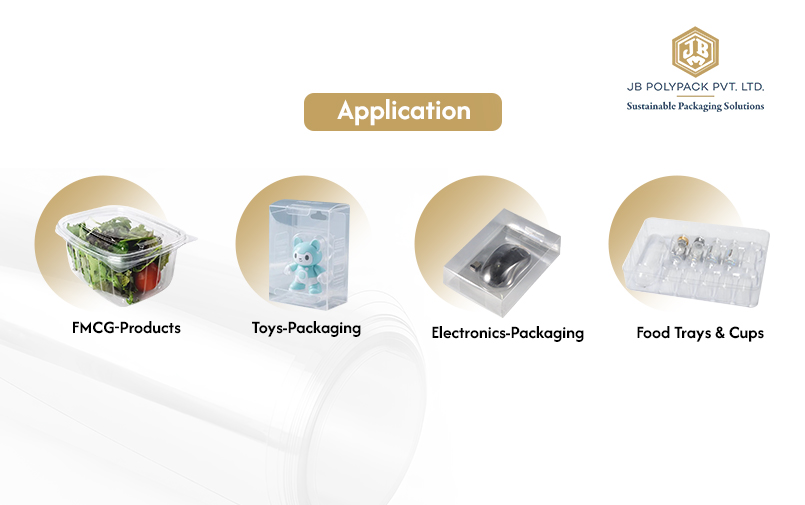
rPET Beyond Food-Contact: The Full Application Range
A misconception worth correcting is that rPET sheet is only relevant for food packaging. Food-contact is the most scrutinised application because of the regulatory framework around it. Outside food contact, rPET performs at full specification equivalence with APET across a wider range of applications than most buyers realise.
Blister and clamshell packaging for non-food consumer goods, including hardware, personal care accessories, and stationery, has no food-contact requirement. GRS-certified rPET serves these applications with the same structural integrity as APET while delivering documented recycled content for brand sustainability reporting.
Internal cavity trays, dividers, and protective inserts used in electronics and industrial component packaging require structural consistency and dimensional stability rather than optical perfection. rPET handles these applications without compromise. The recycled content claim becomes an asset in ESG supplier scorecards even when the end consumer never sees the packaging material.
Agricultural and horticultural packaging, including seedling trays, plant transport trays, and propagation containers, operates in conditions where UV exposure, moisture, and physical handling are the primary stresses. rPET performs equivalently to APET in these conditions, and the lower material cost relative to pharma-grade applications makes it the commercially rational choice.
Retail secondary packaging, shelf-ready trays, and transit packaging where APET’s optical properties add no functional value are natural rPET applications. Buyers running these formats on APET because “that is what we have always used” are leaving EPR compliance value on the table.
APET vs rPET vs PETG: Clarifying the Third Option
Buyers evaluating APET and rPET sometimes have PETG in their consideration set, particularly for folding box applications and point-of-sale display. PETG (Glycol-modified PET) is a different material category and the comparison deserves a direct answer.
PETG incorporates glycol into the PET backbone, which makes it softer and more flexible than APET. It is easier to die-cut on conventional equipment without cracking, which is why it appears in point-of-sale display construction and some pharmaceutical packaging formats. The trade-off is that PETG scratches more easily, requires protective masking during handling, and costs significantly more than APET or rPET.
Critically, PETG is a separate resin type. It does not carry the same recycling stream as standard PET. In a market moving toward EPR recycled content compliance and closed-loop PET recycling, PETG introduces supply chain complexity without a meaningful performance advantage for most standard thermoforming applications.
For buyers choosing between APET and rPET sheets for thermoformed trays, punnets, blister packaging, and rigid formed parts, PETG is not a direct substitute. It addresses a different set of forming and fabrication constraints. If die-cutting performance or impact flexibility is the specific requirement, PETG is worth evaluating on those grounds. For volume thermoforming applications where clarity, food-contact compliance, recycled content, or EPR documentation are the drivers, APET and rPET are the correct material categories to compare.
How APET and rPET Actually Compare Across Procurement Parameters
Rather than treating this as a simple quality hierarchy, buyers are better served by understanding where each material performs without compromise and where one holds a genuine structural advantage.
On optical clarity, APET remains the reference point for applications where absolute transparency is the primary specification, with minimal haze and consistent gloss across roll width. Well-processed rPET in the three-layer food-grade construction achieves clarity suitable for retail produce display and branded food packaging. For high-end display applications where the packaging itself is a visual premium signal, the clarity gap between APET and rPET remains real enough to matter in specification.
On mechanical performance, the gap between APET and well-specified rPET has narrowed significantly as recycling process standards have improved. Certified rPET sheets from suppliers with controlled upstream processes deliver tensile strength and dimensional stability comparable to APET for most standard thermoforming applications.
On food-contact suitability, APET has a simpler certification path. rPET reaches the same food-contact standard through validated decontamination and the three-layer structure, which adds process documentation that buyers need to confirm is in place before specifying.
On environmental impact, the numbers are material to any buyer with sustainability reporting obligations. Studies consistently show that rPET uses approximately 79% fewer greenhouse gas emissions than virgin PET production, with carbon footprint reductions in the range of 30 to 50% depending on feedstock source and energy mix. For brands required to disclose Scope 3 emissions or report against packaging sustainability commitments, switching eligible applications from APET to certified rPET is one of the most straightforward impact reductions available within existing thermoforming infrastructure.
On price, EPR-driven demand for certified rPET has moved rPET pellet prices closer to virgin resin in many periods. Buyers should evaluate total cost including EPR compliance value from GRS-documented recycled content rather than material price alone. A brand using certified rPET reduces its EPR certificate procurement burden, which has a measurable financial value against the 30% rigid packaging recycled content mandate active from FY 2025-26.
On GRS certification and supply chain documentation, rPET holds an advantage APET structurally cannot match. GRS-certified rPET carries independently verified chain of custody documentation that is now a procurement requirement, not a preference, for major FMCG buyers and retailers building EPR compliance portfolios.
Where APET Remains the Correct Specification
Pharmaceutical blister packaging is the clearest case. Regulatory requirements for drug packaging typically specify virgin-grade materials with pharmacopoeia compliance and full resin traceability. This is a documented regulatory position, not a performance preference.
High-frequency RF sealing applications rely on consistent dielectric properties. RF welding used in blister sealing and PVC-replacement packaging in electronics requires surface consistency that APET provides predictably across production runs.
Premium display packaging where the packaging functions as a zero-distortion display window, covering cosmetics, jewellery, and gift packaging, requires optical performance that APET delivers reliably at commercial scale for formats where packaging clarity is the product presentation itself.
Export to markets with virgin material specifications covers situations where the importing country’s regulation or the brand’s internal specification requires documented virgin resin sourcing regardless of sustainability preference.
These are real applications with legitimate APET requirements. The point is that they represent a narrowing segment of total thermoforming demand. Applications where APET is the only viable answer are becoming fewer as certification frameworks for rPET mature and as EPR obligations make recycled content a procurement requirement rather than a preference.
Where rPET Is the Smarter Procurement Choice
Fresh produce punnets and food trays are the highest-volume thermoformed PET application in India. Punnets for grapes, berries, cherry tomatoes, and cut vegetables require structural integrity, ventilation geometry, and food-grade certification. Certified three-layer rPET sheet achieves the visual quality needed for retail produce display while contributing directly to EPR recycled content targets. JB Polypack supplies both recycled PET sheets and thermoformed plastic punnets for this category from within the same Group infrastructure.
Bakery and confectionery packaging, including hinged containers, flat-lid trays, and multi-portion formats, operates in ambient temperature ranges where rPET performs identically to APET. The GRS-certified recycled content these formats carry is commercially relevant in retail supply chains where buyers’ sustainability reporting tracks packaging material composition.
Consumer goods blister and clamshell packaging for hardware, stationery, personal care, and household products has no food-contact requirement. rPET performs at full equivalence with APET in these formats while delivering the recycled content documentation major retailers now require from their packaging suppliers.
FMCG secondary packaging and cavity trays cover applications where the sheet forms internal dividers, multi-unit blister bases, or protective inserts. In these formats optical properties are operationally irrelevant and rPET meets full specification equivalence with APET.
Any brand operating under EPR recycled content obligations should be evaluating rPET for all non-pharmaceutical, non-RF-sealed thermoforming applications. From FY 2025-26, the 30% recycled content mandate for rigid plastic packaging is a legal requirement. Sourcing decisions that continue defaulting to APET across the full product range create compliance exposure that grows as mandatory targets rise to 60% by FY 2028-29.
The EPR Dimension: Why Material Choice Is Now a Compliance Decision
India’s Plastic Waste Management Rules, amended in 2022 and updated in 2025, introduced mandatory recycled content targets for rigid plastic packaging. For FY 2025-26, rigid packaging must incorporate 30% recycled content, rising to 60% by FY 2028-29.
A brand owner or packaging converter using only APET sheets across their thermoformed product range has zero certified recycled content in that portion of their packaging portfolio. Meeting the 30% mandatory target requires either sourcing rPET grades for eligible applications or purchasing EPR recycled content certificates through the CPCB portal, the latter being a financial cost with no operational or brand value.
rPET sheets with GRS certification generate documented recycled content value that directly reduces EPR certificate procurement burden. As of early 2025, CPCB had issued show-cause notices to over 400 producers and importers for failing to meet EPR targets. The enforcement posture has shifted from advisory to active, and major retailers and export-oriented FMCG companies are now requiring that packaging suppliers demonstrate EPR compliance as a condition of approved vendor status.
A PET sheet manufacturer that supplies GRS-certified rPET sheets alongside APET gives customers the ability to manage both performance specifications and compliance requirements from a single supplier relationship.
Thermoforming Considerations for Both Materials
Both APET and rPET sheets run on standard thermoforming equipment. The processing differences are manageable but consequential if overlooked.
Moisture control is critical for rPET. PET is hygroscopic and absorbs atmospheric moisture. Absorbed moisture during re-extrusion causes chain scission and produces acetaldehyde as a degradation byproduct. Drying rPET sheet adequately before thermoforming is standard practice; inadequate drying produces brittle formed parts and visible surface defects.
Forming temperature windows for APET and rPET are similar for most standard applications, but specific rPET grades may require slightly tighter temperature control to avoid surface crystallisation. Well-specified rPET sheet from a controlled production process eliminates this variability.
Trim and regrind management differs between the two materials. For APET, regrind can be reintroduced at standard percentages without significant property degradation. For rPET, regrind adds another heat cycle to already-recycled material; monitoring ensures regrind additions stay within specification. This is a production management parameter, not a reason to avoid rPET.
Surface energy for printing and labelling applies equally to both materials. APET and rPET both require corona or flame treatment for reliable ink adhesion. Buyers specifying printed thermoformed parts should confirm the sheet supplier’s surface energy specification is maintained across both grades.
Questions to Ask Your APET or rPET Sheet Supplier
Evaluating a PET sheet supplier goes beyond the initial quotation. The following questions identify suppliers capable of supporting stable, long-term production rather than one-off orders.
What thickness range and roll widths do you supply?
Confirm the supplier’s standard range covers your forming geometry, and ask whether custom widths or thicknesses are available against specification.
Can you provide grade-specific test reports?
Reputable suppliers provide documentation covering thickness tolerance, optical properties, and mechanical data for each sheet grade. For rPET, ask specifically for GRS certification and FSSAI food-contact documentation where applicable.
What is your feedstock source for rPET?
Vertically integrated suppliers with in-house or Group-level feedstock processing offer greater consistency than those sourcing flakes or pellets from third-party recyclers with variable process discipline.
What PCR content percentage is available, and how is it verified?
Confirm whether the supplier can supply at the specific PCR percentage your EPR recycled content target requires, and whether that percentage is GRS-certified rather than self-declared.
Can you support repeat order consistency across batches?
Optical and mechanical consistency across production runs matters more than single-batch performance. Ask how the supplier manages batch-to-batch variation, particularly for rPET where feedstock variability is a real supply chain consideration.
What is the standard lead time, and can you support export packing requirements? For buyers sourcing from manufacturers rather than distributors, lead times and export documentation capability are procurement-stage qualifiers, not afterthoughts.
Do you supply thermoformed end products as well as sheet?
Suppliers who also convert sheet into formed parts offer the option to consolidate sheet sourcing and thermoforming into a single supply chain relationship, which simplifies traceability documentation for EPR purposes.
JB Polypack’s Position in the APET and rPET Supply Chain
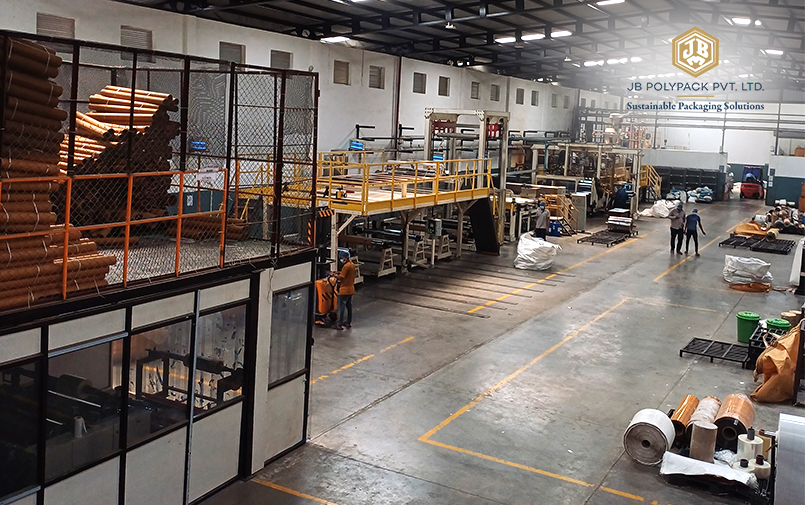
JB Polypack manufactures both APET and rPET rigid sheets within the Jay Bharat Group’s integrated PET circular economy infrastructure. The Group operates across the full PET value chain: collection of post-consumer PET bottles, hot-washing and flake production through JB Ecotex, rPET chip manufacturing, and rigid sheet extrusion through JB Polypack, with thermoformed end products including hinged containers and produce punnets manufactured in-house.
This vertical integration removes a supply chain risk most sheet buyers carry: feedstock quality variance from third-party recyclers. rPET sheet quality is determined upstream, at the flake washing and pelletising stage. When feedstock is produced within the same Group infrastructure, consistency in colour, contamination levels, and material properties is not dependent on an external supplier relationship.
Available grades include APET sheets in a range of thicknesses from 0.25 mm to 3.0 mm in standard thermoforming widths, rPET sheets in three-layer co-extruded food-grade construction with GRS-certified recycled content, and custom thickness and width configurations against buyer specifications. Both APET and rPET sheets are supplied with test reports covering thickness tolerance, optical properties, and mechanical data. Buyers requiring food-contact certification receive applicable FSSAI-aligned documentation.
For sample requests, technical specifications, or to discuss grade selection for your thermoforming application, contact the JB Polypack team directly.
Frequently Asked Questions
Can rPET sheets achieve the same clarity as APET?
Well-certified rPET in a three-layer construction achieves clarity suitable for retail food packaging and most consumer goods applications. For the highest-demand optical applications, such as premium display packaging and cosmetics, APET remains the reference grade. Grade-specific test reports from your supplier are the most reliable basis for this evaluation.
Is rPET sheet more expensive than APET?
EPR-driven demand for certified rPET has moved rPET pellet prices closer to virgin resin in many periods. Buyers should evaluate total cost including the EPR compliance value of GRS-documented recycled content, not material price in isolation. The financial benefit of reduced EPR certificate procurement often changes the cost comparison.
Do I need different thermoforming tooling for rPET?
Tooling geometry does not change between APET and rPET. Processing temperature profiles may require minor adjustment for specific rPET grades, but this is a line setup change, not a tooling modification.
What does GRS certification on an rPET sheet mean for EPR compliance?
GRS certifies the chain of custody from post-consumer material collection through to the finished product. A GRS-certified rPET sheet means the recycled content claim has been independently verified at each production stage. This verification chain is what buyers need to document recycled content use for CPCB EPR compliance reporting.
What PCR content percentage is standard in commercial rPET sheets?
Commercial rPET sheets are available from 30% PCR to 100% PCR content. Three-layer food-grade sheets typically carry 30 to 70% PCR in the core layer, with virgin skin layers maintained for food-contact surface integrity. The appropriate level depends on optical requirements, food-contact certification needs, and the buyer’s EPR recycled content target.
Can APET and rPET production runs be managed on the same thermoforming line?
Yes, provided each run is labelled and managed separately. Buyers with EPR recycled content obligations running both APET and rPET SKUs must maintain clear inventory segregation for audit and documentation purposes. Mixed-grade production without segregation invalidates the GRS chain of custody for the rPET portion.
What is the environmental impact difference between APET and rPET?
Studies consistently show rPET production uses approximately 79% fewer greenhouse gas emissions than virgin PET, with carbon footprint reductions in the range of 30 to 50% depending on feedstock source and regional energy mix. For brands with Scope 3 emissions reporting obligations or packaging sustainability commitments, switching eligible applications from APET to certified rPET is one of the most accessible impact reductions available within existing thermoforming infrastructure.
JB Polypack Pvt. Ltd. is a Surat-based PET packaging manufacturer operating since 1985 as part of the Jay Bharat Group. The company manufactures rigid PET sheets, thermoformed punnets, hinged containers, and PET straps, with GRS certification for recycled content products. For product specifications and sourcing enquiries, visit jbpolypack.com or contact the team.