PET Thermoforming Process: From Sheet Selection to Precision Containers
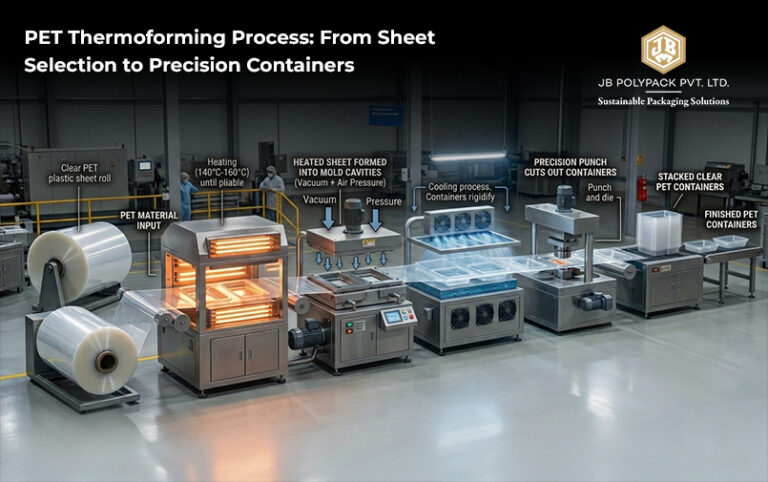
Pick up a clear fruit punnet or a hinged bakery box and it looks like one simple piece of plastic. Behind it is a sequence of steps, and every one of them affects whether the lid snaps shut, whether the boxes stack neatly, and whether the container survives the journey from factory to shelf.
That sequence is the PET thermoforming process. For a brand owner or buyer, understanding it makes it much easier to brief a supplier, compare quotes and spot problems before they reach the customer. The steps below follow the order in which a container is actually made, in plain language, with the questions worth asking at each stage.
What Is the PET Thermoforming Process?
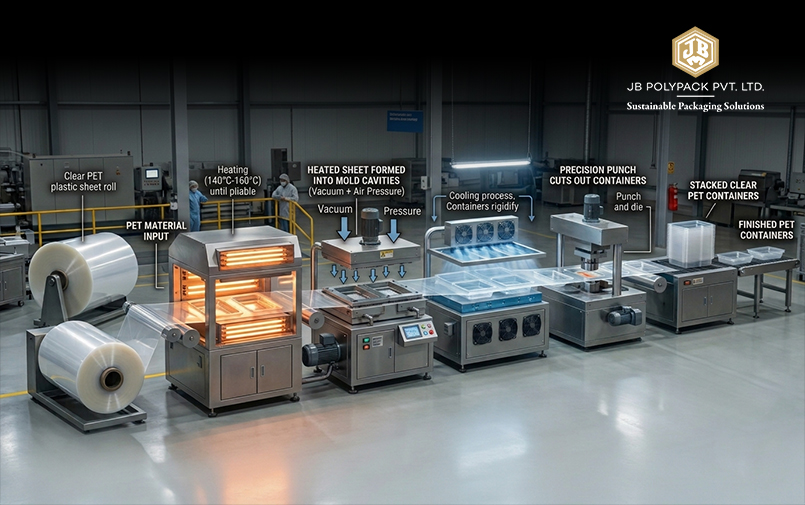
PET thermoforming turns a flat plastic sheet into a shaped container. The sheet is warmed until it becomes soft and flexible, pressed into a mould, cooled so it holds the new shape, and then cut out as a finished part.
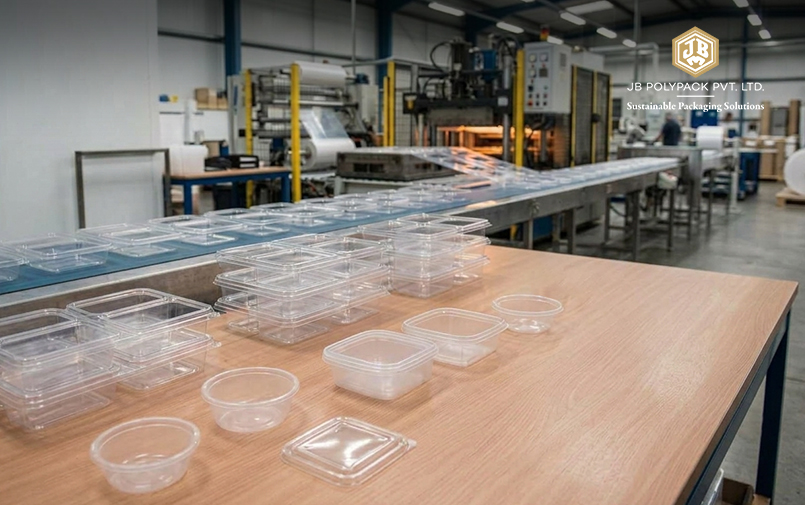
Most thin packaging, such as punnets, trays, clamshells and hinged boxes, is made from sheet that comes on large rolls and feeds continuously into the forming machine. If you are new to the method itself, our overview of thermoforming basics covers the general principles. The focus here is on what happens at each step when the material is PET and the goal is a precise, reliable container.
Step One: Designing the Container
Every PET thermoform begins as a drawing, and the drawing sets limits for everything that follows.
When flat sheet is pushed into a mould, it has to stretch. The deeper and narrower the container, the further the sheet stretches, and the thinner it becomes in the deepest parts. Good container design keeps this in mind from the start:
-Rounded corners stretch more evenly than sharp ones.
-Slightly tapered walls help the container come out of the mould cleanly and help empty containers stack inside each other.
-Sensible depth keeps enough material in the base and lower walls.
-Clearly marked critical areas, such as the lid rim, hinge, base or sealing edge, tell the manufacturer where strength matters most.
Different container types put the stress in different places. A hinged box depends on its hinge and snap closure, while a punnet depends on its base and ventilation holes. Our articles on the uses of hinged plastic boxes and the range of plastic punnets show how these formats differ in practice.
Question to ask: will the manufacturer review your design for formability before any tooling is made?
Step Two: Making the Mould
The mould gives the container its shape. For packaging, one mould usually holds several identical cavities, so each cycle of the machine produces a set of containers at once.
Three things about the mould affect the finished product:
-Cavity shape decides how the sheet spreads out as it forms, and so where the container ends up thick or thin.
-Surface finish affects how cleanly parts release and how clear and glossy they look.
-Cooling inside the mould has to be even. If one cavity runs warmer than another, the containers from that cavity can come out slightly different in size or shape.
For deeper containers, a shaped push tool called a plug assist is often added. It presses the soft sheet down into the cavity before forming is completed, which helps carry material into the base and lower walls.
The cutting tool that trims the containers out of the sheet is designed together with the mould, because the cut has to line up exactly with the formed part.
Question to ask: who designs the mould, who owns it, and how is consistency between cavities checked during trials?
Step Three: Choosing PET Plastic Sheet for Thermoforming
Sheet selection is often treated as a purchasing decision. In practice it shapes the entire PET thermoforming process, because every property of the sheet carries through into the finished container.
Grade. Most clear packaging uses APET (virgin PET) or rPET (recycled PET). rPET brings recycled content into the container, and for food contact it is typically made as a three-layer sheet with recycled material sealed between virgin outer layers. The differences in clarity, compliance and cost are explained in our comparison of APET vs rPET sheets. For buyers who want to trace recycled content further upstream, the material starts as recycled PET chips produced from post-consumer PET.
Thickness. The right sheet thickness depends on the container design. A deep container needs more starting material than a shallow one to finish with walls that are strong enough. Thickness, design and mould should be decided together, with none of them fixed in isolation.
Consistency. Any variation in the sheet shows up again in the finished container. A roll that is even in thickness and quality from start to finish makes the whole process easier to control.
Documentation. For food packaging, the sheet’s food-grade paperwork should be confirmed at this stage. Changing sheet later can mean re-approving the container.
JB Polypack manufactures rigid PET sheet in APET and RPET variants for thermoforming, with custom thickness and sample sheet available for trials.
Step Four: Heating the Sheet
Heating softens the sheet so it can stretch into the mould. With PET, this step needs particular care.
Too little heat and the sheet will not stretch fully. Details like rims and ribs come out soft or incomplete.
Too much heat creates a different problem. When PET is overheated, it starts to crystallise, which makes it cloudy and more brittle. SpecialChem’s technical guide to PET notes that crystallised PET has lower impact strength. For a clear container, that means losing the two qualities buyers usually chose PET for.
Is There a Standard PET Thermoforming Temperature?
People often search for a single correct PET thermoforming temperature. In reality, the right setting depends on the sheet grade, its thickness, the machine, the speed of production and the shape of the container. It is worked out during trials on the actual production line.
What matters more than any single number is evenness. A sheet that is warmer on one side than the other will form differently across the mould, and the containers will vary even if the average temperature looks right.
Step Five: Forming the Container
Once the sheet is soft, it is pressed into the mould. Thin PET packaging is usually formed in one of three ways, often combined:
-Vacuum forming sucks the soft sheet onto the mould by removing the air between them. It is the simplest method.
-Pressure forming adds compressed air from the other side, pushing the sheet harder into the mould. This gives sharper corners, crisper rims and clearer embossed details.
-Plug-assisted forming uses the push tool described earlier to guide material into deeper areas before the final shape is formed.
For containers with snap-fit lids or stacking features, sharp detail directly affects how well the container works. A rim that forms slightly soft may not close firmly or may pop open in transit.
Question to ask: which forming method does the manufacturer plan to use for your container, and why?
Step Six: Cooling
The formed container has to cool inside the mould long enough to hold its shape once it is released. This is where precision is kept or lost.
Uneven cooling can cause slight warping or small differences in size. On a single container, these may be hard to see. On a packing line, they show up quickly: a lid that fits one base but not another, a flange that is not quite flat, or a stack of containers that leans. Even, well-controlled mould cooling is what keeps every cavity producing the same part.
Step Seven: Trimming
After forming, the containers are still joined to the surrounding sheet. Trimming cuts them free.
PET is a tough material, which is one of its strengths in packaging. That same toughness makes it harder to cut cleanly. Plastics Technology’s article on why PET is tough to trim explains that the trimming method and tool setup need to suit PET specifically.
For a buyer, trimming matters for two reasons:
-The cut edge is what consumers touch. Rough edges or small burrs feel cheap and can snag film or labels.
-The rim and flange size decide whether a lid seals, a sleeve slides on, or a label fits. A container can form perfectly and still fail its specification at the trimming stage.
Well-maintained, sharp cutting tools that line up precisely with the formed parts keep edges clean and dimensions consistent.
Step Eight: Checking and Stacking
At the end of the line, containers are counted, stacked and packed. Samples are checked against the drawing. The checks that matter most for PET containers are:
-Key dimensions, such as rim size, flange width and height.
-Lid and base fit, including between containers from different cavities.
-Stacking and de-stacking, since containers that stick together slow down filling lines.
-Wall thickness at the thinnest points, usually corners and bases.
Question to ask: which points will be measured, how, and how often? Agreeing this in writing means supplier and buyer are checking the same things in the same way.
Step Nine: Recovering the Leftover Sheet
Once the containers are cut out, a frame of leftover sheet, often called the skeleton, remains. The layout of cavities in the mould decides how much of it there is, and it forms part of the material cost of every container.
PET skeleton can be recovered and reprocessed. Within the Jay Bharat Group, PET recycling runs across several stages, from post-consumer bottles to PET flakes and on to recycled material. For buyers tracking recycled content or waste in their supply chain, asking how a manufacturer handles its skeleton is a reasonable question.
Why Container Walls Vary in Thickness
Thermoforming thickness variation is normal, and understanding why helps buyers set sensible specifications.
A flat sheet of even thickness cannot stretch into a three-dimensional shape and stay even everywhere. Areas that stretch the most, usually deep corners and the lower parts of the walls, end up thinnest. The flange and upper walls, which stretch less, stay closer to the original sheet thickness.
This kind of predictable variation is different from a defect. The aim is to make sure the thin areas are still strong enough for the job. Four things help:
-Design: rounder corners and moderate depth.
-Mould and plug assist: guiding more material into the deep areas.
-Sheet: the right starting thickness and even quality across the roll.
-Process: even heating and controlled cooling.
The most useful change a buyer can make is to specify a minimum wall thickness at the points that matter, instead of only stating the starting sheet thickness. The sheet thickness says very little about how strong the finished container’s corners will be.
Where PET Thermoforming Packaging Is Used
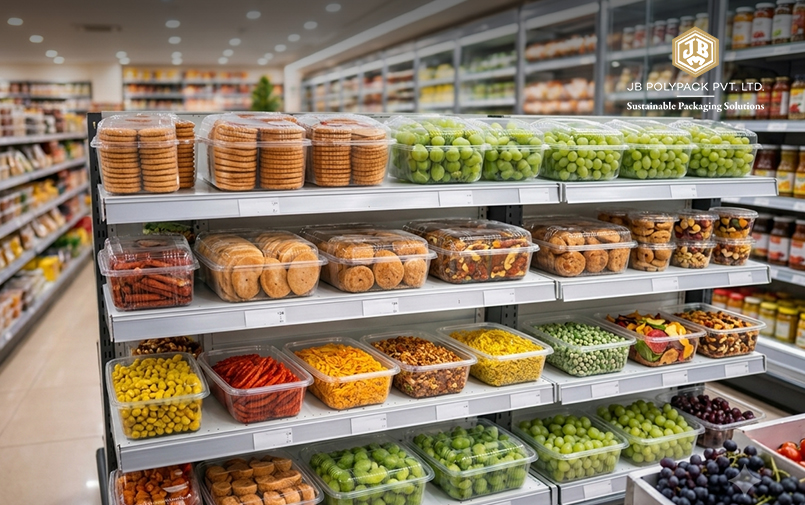
The same process produces a wide range of containers. The most common include:
-Punnets for fruit, berries and vegetables, where ventilation and base strength matter most. See our range of plastic punnets.
-Hinged boxes and clamshells for bakery, snacks, takeaway and retail items. Our article on how hinged plastic boxes serve multiple industries covers these uses in more detail, and we also look at hinged boxes and sustainability.
-Food trays and inserts that protect products during storage and transport, a subject covered in our piece on how plastic packaging reduces food damage.
Choosing a PET Thermoforming Manufacturer
When comparing PET container manufacturers, the process itself gives you a practical checklist:
1.Will they review your container design before making the mould?
2.Who designs and owns the mould and cutting tools?
3.Which forming method do they propose, and why?
4.Where does their PET sheet come from, and how is its consistency controlled?
5.How do they check trimming quality and rim dimensions?
6.Which points on the container are measured, and how?
7.What food-grade documentation comes with the sheet and the finished container?
8.What does the sampling and trial process look like before production is approved?
Clear answers to these questions tell you more about a manufacturer’s precision than any brochure.
JB Polypack, part of the Jay Bharat Group in Surat, manufactures both PET sheet and thermoformed PET punnets and hinged boxes. If you are planning a new PET container, get in touch with our team with your drawing, the product it will hold and your expected volumes.
Frequently Asked Questions
How does PET thermoforming work?
PET thermoforming heats a flat PET sheet until it is soft, presses it into a mould using vacuum, air pressure or a plug, and cools it so it holds the new shape. The formed containers are then trimmed out of the remaining sheet, checked and stacked. Thin packaging is usually made from rolls fed continuously into the machine.
What is the PET sheet thermoforming process step by step?
The main steps are designing the container, making the mould, choosing the PET sheet, heating it, forming it in the mould, cooling it, trimming the containers out, checking and stacking them, and recovering the leftover sheet. Each step affects the next, so decisions made early in design and sheet selection shape the quality of the final container.
What causes thermoforming thickness variation?
Thickness variation happens because a flat sheet stretches unevenly when it is formed into a container. Deep corners and lower walls stretch the most and become thinnest. It is managed through rounder design, plug assist, the right starting sheet thickness and even heating. Buyers should specify minimum wall thickness at critical points.
What temperature is PET thermoformed at?
There is no single temperature that suits all PET thermoforming. The right setting depends on the sheet grade, thickness, machine and container shape, and it is set during production trials. The sheet must be soft enough to form fully without overheating, because overheated PET turns cloudy and brittle. Even heating matters more than any one number.
What should I look for in a PET thermoforming manufacturer?
Look for a manufacturer who reviews your design before tooling, explains their forming and trimming methods, controls the quality of their PET sheet, measures containers at agreed points, and provides food-grade documentation. A clear sampling and trial process before production is also a good sign of reliable precision.