Why Product Packaging Is Essential for Brand Growth and Business Success
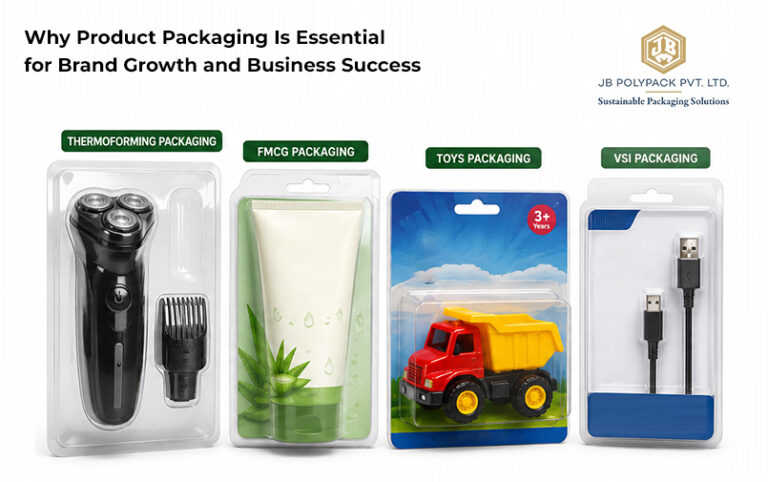
We manufacture PET packaging for food, FMCG, retail, and export brands out of Surat, and the question we get asked most often is not about price. It is some version of: why did our packaging look fine in the sample room and then fail once it hit the actual supply chain. The answer almost always traces back to a decision that got made too late, or made by the wrong department, somewhere between choosing a material and approving the artwork.
This is the gap we want to address here. Most content on packaging and branding talks about shelf appeal and consumer psychology while skipping the manufacturing and material decisions that determine whether a package survives long enough for any of that psychology to matter. We sit on the manufacturing side of this conversation every day, and what follows is our perspective on what actually drives packaging performance, and why that performance is inseparable from brand growth.

Packaging Decisions Are Made Earlier Than Most Brands Realise
By the time a brand team is choosing colors and finalising a label, the packaging’s fate has usually already been decided. Material grade, sheet thickness, and forming tolerance get locked in long before anyone looks at artwork, and those upstream choices set the ceiling on what the finished pack can do.
We see this most clearly in thermoformed PET packaging, which is what we manufacture day to day. A punnet box or hinged container is formed from a flat PET sheet that is heated and drawn over a mould. The clarity, rigidity, and stacking strength of the finished container are inherited directly from the sheet that goes into the machine. If the sheet specification was chosen on price alone, no amount of design work afterward fixes the gap. This is the order we encourage every client to follow: define what the product needs to survive, choose the material grade against that requirement, and only then move into design and branding.
Why Clarity Is a Commercial Decision, Not a Cosmetic One
PET earned its place as the default material for food, bakery, and fresh produce display because of optical clarity, and clarity is one of the few packaging properties a buyer evaluates in under a second, standing in front of a shelf.
In categories where the customer is buying with their eyes, fruit, bakery items, confectionery, ready-to-eat trays, a cloudy or hazy container undercuts the product before the customer reads a single word on the label. We have watched brands invest heavily in label design while sourcing the underlying sheet on price, and the mismatch is visible the moment the product reaches the shelf. A premium label on a hazy box reads as a contradiction, and customers notice contradictions faster than they notice good design.
This is also where the case for PET over alternatives like polypropylene becomes a commercial argument rather than a technical one. Polypropylene at comparable stiffness typically carries visible milkiness that PET does not. For a brand whose entire positioning rests on freshness or premium quality, that visual difference is not a minor spec line, it is the first impression the product makes.
If you want the deeper material mechanics behind this, including thickness and forming behaviour, we have covered that in detail in our guide on PET sheet thickness, clarity, and strength, and in our piece on the role plastic packaging plays in reducing food damage. Our focus here is the business consequence of getting that material decision right or wrong rather than the engineering detail itself.
What We See When Brands Compete on the Same Shelf
We supply packaging to multiple brands operating in the same categories, sometimes the same retail aisle, and this gives us a vantage point most individual brand teams never get. Two products with similar pricing and similar positioning rarely perform identically on shelf, and the gap is visible well before either brand’s marketing team has gathered a single data point on it.
The difference is rarely the artwork. It is almost always whether the packaging holds its shape after a week in a warm retail environment, whether the seal still looks crisp after handling, and whether the clarity has held up or started to fog from condensation cycling. A brand that chose a heavier gauge sheet, or a properly anti-fog treated lid, looks more premium on day seven than a competitor who chose a thinner, cheaper option that looked identical on day one. Customers cannot articulate this difference in a survey, but they respond to it at the shelf.
This is the part of brand growth that rarely makes it into a marketing meeting, because by the time a product is sitting on a shelf for a week, the packaging decision was made months earlier and nobody in the room remembers it was a decision at all. We try to flag this to clients early, because retrofitting a better material specification after a launch is far more expensive than specifying it correctly the first time.
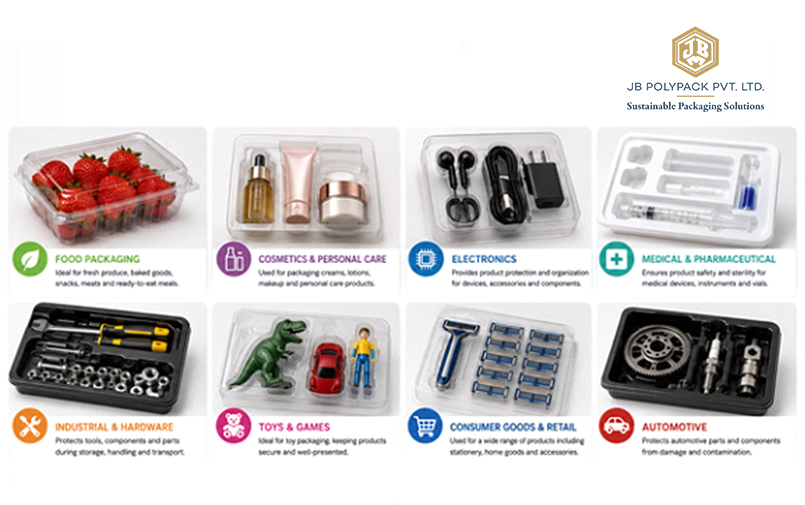
Thermoforming Gives Brands Flexibility That Other Processes Don’t
Thermoforming is the process we use to convert PET sheet into punnet boxes, hinged containers, and trays, and the reason it matters for brand growth specifically is speed and flexibility rather than raw unit cost.
Tooling for thermoforming is considerably cheaper than injection moulding tooling, and lead times for a new mould or a modified cavity are measured in weeks rather than months. For a brand launching a new SKU, adjusting a pack size for a seasonal promotion, or responding to a retailer’s request for a different format, that flexibility often matters more than shaving a few rupees off the unit cost of a high-volume injection-moulded alternative. We have written more on where this flexibility gets used in practice in our piece on thermoforming applications for hinged plastic box packaging, which goes well beyond the food categories most buyers default to.
This kind of responsiveness rarely shows up in a packaging brief, but a brand that can request a modified cavity shape or a slightly larger format mid-season, and get it turned around in weeks rather than months, has a real shot at hitting a seasonal retail window that a slower supplier relationship would miss entirely.
The tradeoff worth understanding honestly: thermoforming is not the right process for every application. Very high-volume, structurally demanding parts with complex undercuts are usually better served by injection moulding once volume justifies the tooling cost. A brand evaluating packaging options should ask a supplier which process actually fits their volume and format, rather than assume one process is universally superior.
The Sustainability Claim Has to Survive Scrutiny
“Sustainable packaging” is one of the most searched terms in this industry and also one of the most loosely used. A label that says recyclable or eco-friendly with no certification behind it is a liability waiting to surface, whether through a retailer’s compliance team, an export buyer’s audit, or a customer who simply checks.
The credible version of a sustainability claim rests on certification rather than adjectives. The Global Recycled Standard (GRS) verifies that recycled content in a product is tracked through the supply chain and meets defined environmental and social criteria, and a GRS-certified supplier can show a chain of custody for the recycled material in the packaging, which is what a serious buyer or auditor will actually ask to see. We hold GRS Scope certification at JB Polypack, alongside food-grade documentation for our thermoformed products, and we treat this as table stakes for working with brands whose sustainability claims need to hold up under scrutiny.
If your business wants to make a sustainability claim of its own, the first question to ask any packaging supplier is simple: can they show the certificate, and does it cover the specific product being purchased. A vague answer from the supplier eventually becomes a vague claim the brand makes to its own customers, and that gap gets noticed.
The Regulatory Layer Most Brand Owners Underestimate
India’s plastic packaging regulation has tightened considerably, and the businesses that treat this as a compliance afterthought are the ones who get caught out at the worst possible moment, usually during a customs hold or a retailer audit.
Under the Plastic Waste Management Rules, any business that produces, imports, or sells goods using plastic packaging in India is classified as a Producer, Importer, or Brand Owner, commonly referred to as a PIBO. PIBOs are required to register on the centralized Extended Producer Responsibility (EPR) portal operated by the Central Pollution Control Board, and to meet recycling and waste collection obligations tied to the volume of plastic packaging they place in the market. This obligation sits with the brand owner rather than the packaging supplier, a point that surprises a number of business owners who assume compliance is somehow built into the material they buy.
A brand that sells under its own name, in its own packaging, carries this EPR responsibility regardless of how small the operation is. Working with a packaging partner who understands these obligations, and who can supply documentation that supports a brand’s own EPR filing, removes one layer of risk that otherwise tends to surface only when it is too late to fix quietly.
How Packaging Failure Shows Up in Business Numbers
It is worth being specific about what happens when packaging decisions go wrong, because the cost rarely shows up as a single line item labelled packaging failure.
It shows up as a higher than expected return rate in e-commerce, where a box that was not matched to courier handling conditions lets the product arrive damaged. It shows up as a rejected export consignment, where a punnet box failed to hold its shape under the load stacking conditions of a sea freight container, a problem we have covered in detail from the exporter’s side in our piece on punnet box suppliers and global shipping standards. It shows up as a retailer delisting a product after repeated complaints about packaging that did not protect freshness as long as claimed on the label. And less visibly, it shows up as a brand quietly losing the trust of a buyer who once chose them over a competitor, because the unboxing experience or shelf condition no longer matched the brand’s own marketing.
None of these are design failures. They are specification failures, made earlier in the process than most marketing teams ever see.

A Word on E-commerce Packaging Specifically
E-commerce packaging fails differently than retail shelf packaging. A box designed to look good in a store display is judged by a human eye at a fixed distance. A box moving through e-commerce logistics is judged by drop tests, conveyor belts, and stacking in delivery vans, often with far less care than a retail employee would apply.
Rigid PET formats, particularly hinged and punnet styles, tend to perform well here because the same clarity and impact resistance that makes a product look good on a shelf also helps it survive rougher last-mile handling. The brands getting this right are testing their packaging against real courier conditions before launch, rather than assuming retail-grade packaging will simply transfer over to a delivery van.
Where This Leaves a Business Owner
Packaging is rarely a downstream decision that happens after the product and the brand identity are finalised. It functions as an upstream decision that determines whether the product survives long enough, and looks credible enough, for the brand identity to matter at all. The brands that get the most commercial value out of their packaging are the ones that treat material selection, regulatory compliance, and certification as seriously as they treat their logo and their tagline.
If you are evaluating a packaging partner for your next product run, ask for the certification, ask how the material has performed in conditions similar to yours, and ask who carries the EPR responsibility once the product leaves your warehouse. A supplier who answers these clearly is one worth building a long-term relationship with.
We work with food, FMCG, retail, and export businesses on exactly these decisions every day, from PET sheets and punnet boxes to hinged thermoformed containers for bakery and ready-to-eat formats. If you want to talk through what the right specification looks like for your product, get in touch with our team.
Frequently Asked Questions
Why does packaging matter for brand growth?
Packaging affects product survival in transit, shelf presentation, and regulatory compliance. A brand’s growth depends on packaging performing reliably rather than simply looking attractive, since failures in transit or compliance damage trust faster than design can build it.
Why is clarity important in PET packaging?
Clarity affects purchase decisions directly in categories like fresh produce and bakery, where customers judge product quality visually before reading any label. PET offers higher clarity than many alternative plastics, which is why it remains the default choice for display-driven categories.
What is the advantage of thermoforming over injection moulding for packaging? Thermoforming uses lower-cost tooling and shorter lead times, making it more practical for brands with frequent SKU changes or moderate volumes. Injection moulding remains more economical at very high volumes where tooling cost is fully amortised.
Is PET packaging considered sustainable?
PET packaging can be genuinely sustainable when it uses certified recycled content, such as GRS-certified rPET, sourced from a supplier with verifiable food-grade and chain-of-custody documentation. Uncertified claims should not be treated as proof of sustainability.
Who is responsible for EPR compliance on plastic packaging in India?
The brand owner, importer, or producer placing the packaged product in the market carries EPR compliance responsibility, separate from the packaging manufacturer. This applies regardless of business size under the Plastic Waste Management Rules.
What should a business ask a packaging supplier before placing an order?
A business should ask for food-grade compliance documentation, recycled content certification where claimed, and proof of how the material performs under conditions similar to its own supply chain, rather than relying on general claims about quality or sustainability.