Thermoforming Applications You Didn’t Know for Hinged Plastic Box Packaging
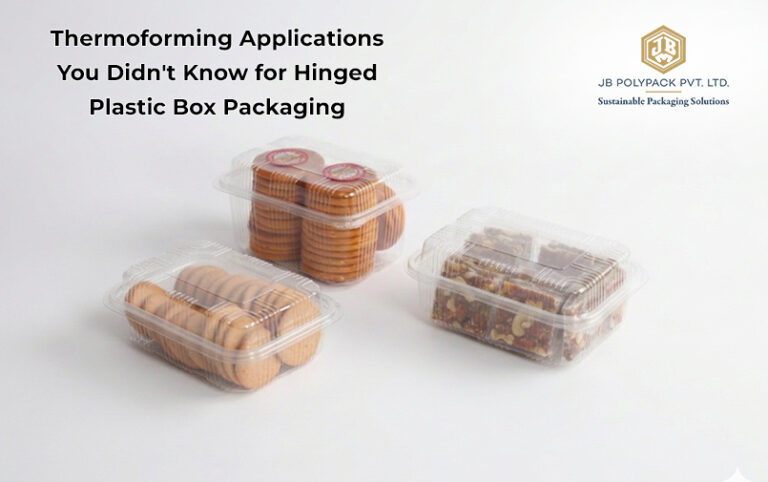
Most buyers searching for a hinged plastic box already know the obvious use: food packaging. Bakery items, fresh produce, takeaway meals. That category is real, it is large, and it is still growing. Hinged Lid Container Market Revenue was valued at USD 3.5 Billion in 2024 and is estimated to reach USD 5.8 Billion by 2033, growing at a CAGR of 6.5% from 2026 to 2033.
But here is what the market reports and most supplier blogs leave out: the same thermoforming technology and the same PET material that produces your standard food-grade clamshell is being applied to categories that procurement teams almost never associate with plastic box packaging. Pharmaceutical kits. Electronics component handling. Cosmetics retail. DIY hardware. Craft supply organisation.
If your business falls into any of these categories, and you are currently using cardboard inserts, foam trays, injection-moulded cases, or heat-sealed pouches, this article is for you. We will walk through specific thermoforming applications for hinged plastic containers that most buyers overlook, and explain why the material and process makes practical and commercial sense for each one.
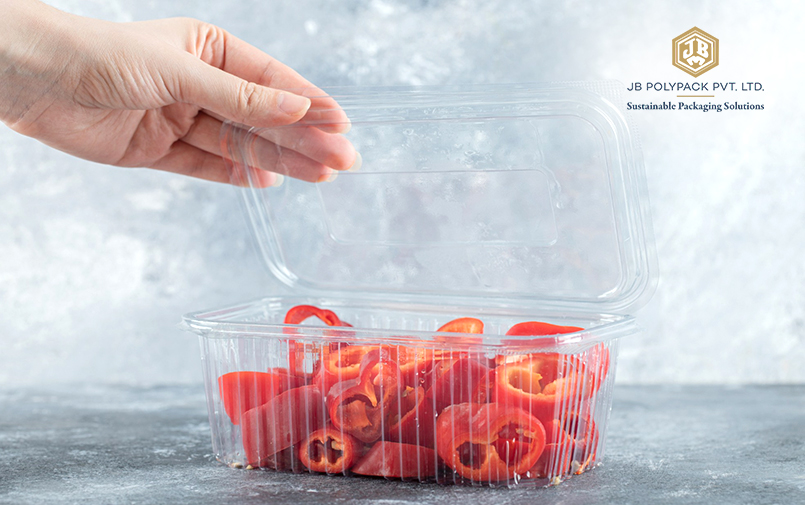
What Thermoforming Plastic Actually Does That Other Processes Cannot
Before getting into applications, it is worth being precise about why thermoforming produces a different result than injection moulding or vacuum forming alone.
Thermoforming plastic involves heating a flat PET or APET sheet to its softening point, then forming it over a mould using vacuum or pressure, then trimming the finished part. The hinge on a thermoformed box is formed in the same cycle as the base and the lid. There is no separate assembly step. The hinge is a thinned, controlled section of the same material, which means the snap performance and repeated-use durability depend entirely on sheet gauge and forming precision.
This has two consequences that matter to buyers:
First, tooling costs are significantly lower than injection moulding for comparable volumes. A steel injection mould for a hinged lid storage box at the same scale can cost 5 to 10 times more than a thermoforming aluminium tool.
Second, the production cycle for thermoforming packaging is faster to change over. If you need to shift from a 250ml box to a 500ml box, or add ventilation holes, or change the lid geometry, the lead time for a new thermoforming tool is measured in weeks, not months.
For buyers with SKU variation, seasonal packaging changes, or product launches on short timelines, those two factors alone often make thermoforming packaging the more practical choice even when the per-unit cost at very high volume is slightly above injection moulding.
What Makes a Hinged Plastic Box Work in Thermoforming Packaging
A plastic box with hinged lid built through thermoforming packaging behaves very differently from injection molded or flexible formats.
Core structural advantage
Thermoforming allows controlled material distribution.
Instead of uniform thickness, material gets stretched based on mold design.
That leads to:
• Reinforced corners
• Flexible hinge zones
• Rigid base support
This is why a properly designed hinged plastic containers format can stay lightweight while handling load.
Hinge performance matters more than you think
The hinge is the failure point in most cases.
In thermoforming:
• Living hinges are created by thinning the material intentionally
• Cycle life depends on polymer grade and hinge radius
If you are using a hinged lid storage box in repeated open-close environments like retail or tools, hinge fatigue becomes a real cost factor.
Most buyers miss this during sampling.
Where Hinged Plastic Box Outperforms Other Packaging Formats
Let’s get practical. When should you actually choose this over cartons, pouches, or injection molded boxes?
1. When product visibility drives conversion
A small clear plastic box with hinged lid removes the need for window cutouts or secondary display packaging.
Used in:
• Hardware retail
• Cosmetics
• Accessories
You save on:
• Printing cost
• Assembly time
• Packaging layers
2. When internal movement causes damage
Loose packaging kills product quality.
With thermoformed plastic containers, you can design:
• Product-fit cavities
• Snap holds
• Multi-compartment layouts
This is critical in:
• Electronics
• Medical kits
• Precision components
A hinged plastic box here acts as both packaging and protective structure.
3. When packing line speed matters
Separate lids slow down operations.
A plastic box with hinged lid eliminates:
• Lid alignment
• Lid inventory
• Manual fitting
In high volume environments, this directly reduces cycle time.
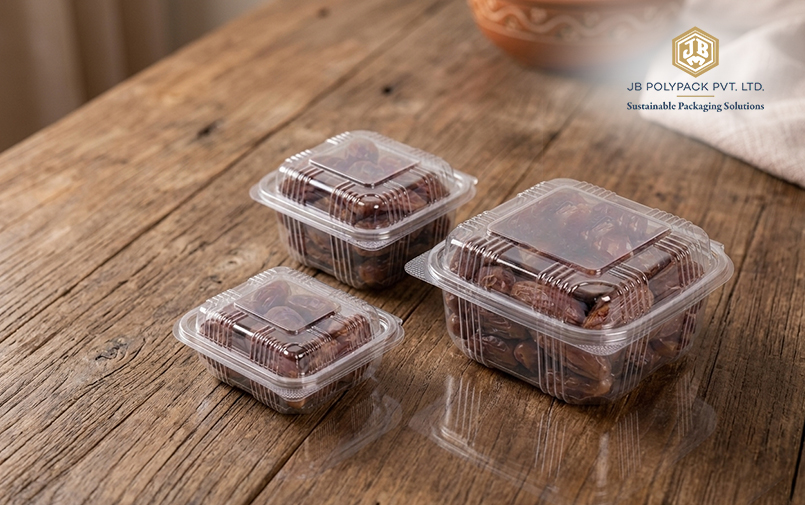
7 Thermoforming Applications for Hinged Plastic Boxes That Most Buyers Overlook
1. Pharmaceutical Sample and Kit Packaging
This is the single most underused application we encounter. Medical and pharmaceutical companies routinely ship sample kits, first-aid combination packs, or diagnostic unit packs in cardboard cartons with loose inserts. The carton protects the outer; it does nothing for internal organisation or tamper visibility.
A plastic box with hinged lid thermoformed from food-grade or medical-grade APET solves multiple problems at once. The box is crystal clear, so contents are visible without opening. The snap closure provides a degree of tamper evidence without requiring a separate seal. Custom cavity inserts can be formed into the base to hold vials, blister packs, or swab applicators in fixed positions during transport.
Critically, PET thermoformed plastic containers carry no plasticiser risk. APET does not contain phthalates or BPA, which are concerns in PVC-based alternatives. For pharmaceutical procurement teams specifying packaging materials, this is a specification requirement, not a preference.
The size range for this application typically falls in the small hinged storage box category: 100ml to 400ml internal volume, with 2 to 4 fixed cavities. These are produced to tight dimensional tolerances because the cavities must hold specific item sizes without movement.
2. Electronics Component Trays for Assembly Lines and Retail
Anti-static versions aside, standard clear thermoformed PET hinged containers are used extensively in electronics assembly and retail for non-sensitive parts: connectors, screws, gaskets, cable ties, and small PCB components.
The advantage over cardboard or polystyrene trays is primarily visual. On a production floor, operators picking small components from clear thermoformed plastic containers can identify content without label lookup. In retail, a small clear plastic box with hinged lid presenting cables, adapters, or accessory kits allows the product to sell itself without additional display investment.
The structural rigidity of APET at 0.3mm to 0.5mm gauge is sufficient for parts weighing up to approximately 500 grams without lid deformation. Beyond that weight threshold, gauge increases to 0.7mm to 1mm provide the structural performance needed for heavier components.
One detail that procurement teams often miss: thermoformed PET is compatible with standard label stocks and inkjet overprint. You can apply a barcode or QR label to the exterior of a thermoformed box without any pre-treatment, which integrates cleanly with warehouse management and retail EAN systems.
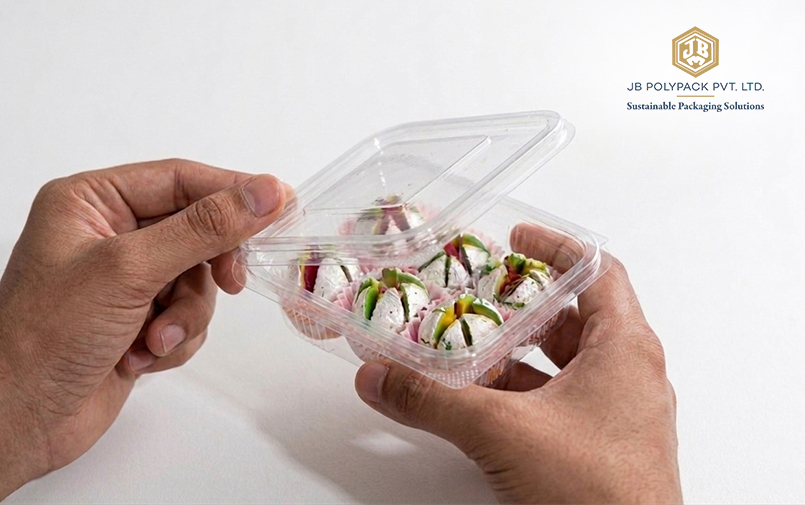
3. Cosmetics and Personal Care Retail Sets
Gift sets, travel kits, and bundled personal care products have traditionally been packaged in rigid cardboard boxes with foam or card inserts. The logic was brand aesthetic: paper-based packaging photographs well and feels premium.
That logic is shifting. A hinged lid storage box in clear PET performs three functions simultaneously that paper cannot: it provides structural protection for fragile items like glass vials or pressed powder compacts; it creates visual display value so the consumer sees exactly what they are purchasing; and it is fully recyclable at end of use in standard PET streams.
For buyers sourcing thermoforming applications in cosmetics, the key spec consideration is the forming depth. Deeper draws are needed for tall bottles or cylindrical containers. Pressure forming, rather than vacuum forming alone, produces sharper cavity definition at greater depth, which matters when the insert needs to hold a specific bottle neck without rattle.
Brands in this category are also responding to regulatory pressure. The EU Packaging and Packaging Waste Regulation that entered force in February 2025 tightens recyclability requirements. A mono-material APET thermoformed box with a PET label is a far cleaner recyclability story than a composite cardboard-foam-plastic laminate. For procurement teams buying for EU-destined products, this is a compliance-relevant consideration in 2026.
4. Fresh Meal Kit and D2C Food Shipping
This application sits between food packaging and logistics, and it is growing faster than the broader hinged container market. Meal kit services and D2C specialty food brands ship gourmet ingredients directly to consumers. The container must survive a logistics journey and then function as a kitchen storage vessel once the consumer receives it.
A standard takeaway clamshell is optimised for the first purpose but fails the second. It has no meaningful re-sealability after the initial snap closure is opened.
Thermoformed hinged plastic containers engineered for this application use a dual-snap closure geometry, where the lid edge wraps around the base edge on multiple contact points rather than a single snap point. This allows the box to be opened and re-closed multiple times while maintaining enough closure force to prevent accidental opening during refrigerator storage.
The material specification for this application is APET or RPET at 0.5mm to 0.8mm gauge, with food-grade certification and clarity maintained even after refrigeration at 4°C. At JB Polypack, our RPET sheet for this application is manufactured from post-consumer recycled PET and meets international food-grade standards, which means the finished container supports both performance and sustainability positioning for D2C brands.
5. Hardware, Craft, and Hobby Organiser Boxes
The clear hinged container market research from IndexBox specifically identifies this segment as driven by DIY trends, small business formation, and hobbies including crafting and electronics. It is fragmented, with many small manufacturers serving local needs. That fragmentation is exactly the market gap that buyers can exploit.
A small hinged storage box in clear PET for hardware or craft organisation competes directly against injection-moulded polypropylene organisers on several commercial dimensions:
Visibility. A clear PET box shows contents instantly. Polypropylene organisers are typically translucent at best, opaque at worst.
Stackability. Thermoformed boxes can be designed with a flat lid profile and a recessed base, so stacks interlock without sliding.
Unit economics at moderate volume. For volumes between 5,000 and 100,000 units, thermoforming tooling cost is substantially below injection moulding. For buyers launching a new SKU, this lowers the minimum viable order commitment significantly.
The specific draw for this segment is the small clear plastic box with hinged lid in the 50ml to 200ml range: seed packets, fishing hooks, beads, resistors, small drill bits, jewellery findings. These items need individual compartmentalised storage, clear visibility, and a closure secure enough that the box survives being moved in a toolbox or craft drawer.
6. Institutional and Retail Bakery Display
This is not a new application, but it is an evolving one that buyers often purchase suboptimally because they default to commodity clamshells without specifying the features that actually matter to their use case.
A bakery clamshell purchased on price alone often produces problems: fogging from condensation on warm product, weak snap closures that fail when stacked, or lid warp under heat during loading.
The correct specification for a hinged plastic box in bakery use addresses all three:
Anti-fog coating on the inner lid surface maintains visibility of the product throughout the display period. This is an additive applied during sheet manufacture, not a post-treatment.
Gauge selection for the intended stack height. A four-high stack of full-size clamshells at 300g fill weight per box requires a different gauge calculation than a single-unit retail display box.
Hinge geometry matters more than most buyers realise. A wide, shallow hinge section distributes flex stress across a larger material area. A narrow hinge concentrates stress at a single point and fails after fewer open-close cycles. For bakery boxes that are opened once by the consumer, narrow hinge geometry is acceptable. For institutional boxes used by kitchen staff who open and close repeatedly during service, a reinforced hinge profile is the correct specification.
7. Export and Transit Packaging for Fragile Non-Food Goods
This is perhaps the most counterintuitive application on this list. When people think of thermoforming plastic for export packaging, they think of foam or cardboard. But thermoformed PET hinged containers are used for transit packaging of small-value fragile items including decorative ceramics, glass components, and precision instruments when the volume per shipment is moderate and the cardboard outer is doing primary structural work.
In this configuration, the thermoformed box functions as an inner tray within a corrugated outer. The product sits in a custom cavity inside the thermoformed base. The hinged lid holds the top face of the product in position. The corrugated outer absorbs impact. The thermoformed insert prevents the product from moving within the outer during transit.
The advantage over foam inserts is twofold: thermoformed PET is fully recyclable at the destination, which matters for export to markets with extended producer responsibility regulations. And thermoformed cavities can be dimensioned to sub-millimetre accuracy, which foam cutting cannot achieve without CNC equipment that adds cost.
Choosing the Right Hinged Plastic Box for Your Use Case
If you are evaluating options, focus on these factors:
1. Material type
PET works well for clarity and recyclability.
2. Thickness
Depends on product weight and protection needs.
3. Closure strength
Snap fit should match usage frequency.
4. Cavity design
Critical for product stability.
5. Volume requirements
Higher volumes justify custom molds in thermoforming packaging.
A good supplier will guide these decisions based on your application.
How to Specify a Hinged Plastic Box Correctly Before You Order
Buyers who approach thermoformed plastic box procurement with only product dimensions and a target price invariably receive quotes that miss the functional requirements. The following specification points determine actual performance:
Sheet material. APET for food contact, RPET for sustainability-positioned products, PETG where higher impact resistance at lower temperature is needed. Each has different forming characteristics that affect which applications they suit.
Gauge. Specify the finished wall gauge, not the input sheet thickness. Thermoforming thins the material during forming. A 0.5mm input sheet may produce a 0.35mm wall in deep draw sections.
Hinge specification. State the expected open-close cycles and the load on the lid. A consumer-use bakery box and an industrial parts handling tray have completely different hinge requirements even if their external dimensions are identical.
Closure force. If the box needs to stay closed under transport vibration or stack weight, specify the minimum snap force. This determines the snap geometry, not just the hinge.
Food-grade requirement. If content will contact the plastic, specify this explicitly. It determines resin grade, any colourant restrictions, and certification documentation required.
Why Thermoforming Packaging from JB Polypack Addresses These Applications
JB Polypack has manufactured thermoformed PET packaging from Surat since 1985 as part of the Jay Bharat Group. Our production uses APET and RPET sheets manufactured from post-consumer recycled PET flakes, which means our thermoforming plastic inputs are traceable, certified food-grade, and produced within a vertically integrated process.
The specific advantage for buyers outside the standard food packaging category is our tooling flexibility. We work with aluminium moulds that accommodate rapid design iteration, which is relevant when you are adapting a standard thermoformed box geometry to a new cavity configuration or adding features like ventilation, anti-fog lining, or a modified snap closure.
Our hinged plastic containers and punnet boxes are currently supplied to food, retail, FMCG, and institutional buyers across India and for export. If your application falls in one of the seven categories described above and you are currently using a packaging format that underperforms, we are equipped to develop a thermoformed PET solution to specification.
Contact our team through jbpolypack.com to discuss your specific application, minimum order volumes, and tooling options.
Frequently Asked Questions
Can a hinged plastic box be made from recycled PET and still meet food-grade standards?
Yes. RPET produced from food-contact post-consumer bottles, properly sorted and processed through food-grade washing lines, can meet international food-contact safety standards. JB Polypack uses food-grade RPET sheets for this purpose.
What is the minimum order quantity for custom thermoformed boxes?
This depends on tooling amortisation. For standard mould sizes, minimum order quantities typically start from 5,000 to 10,000 units. Custom cavity configurations with new tooling may require higher MOQs to recover tooling cost within a competitive unit price.
How does a thermoformed hinged lid storage box compare to an injection-moulded alternative?
Thermoforming produces thinner wall sections and is more economical at moderate volumes. Injection moulding produces thicker, stiffer walls and is more economical at very high volumes where tooling cost is fully amortised. For applications requiring clear visibility and moderate volume, thermoforming is typically the correct process.
Are thermoformed plastic containers compatible with Modified Atmosphere Packaging (MAP)?
Standard APET thermoformed containers are not inherently gas-barrier. For MAP applications, a barrier coating or a multi-layer sheet incorporating EVOH or similar barrier material is needed. This is a sheet specification change, not a forming process change.
JB Polypack Pvt. Ltd. is a Surat-based PET packaging manufacturer and part of the Jay Bharat Group. We supply thermoformed PET products, including hinged plastic boxes, punnet boxes, and rigid PET sheets for food, retail, and industrial applications. Learn more at jbpolypack.com.