Top Benefits of PET Thermoforming Packaging for FMCG Brands
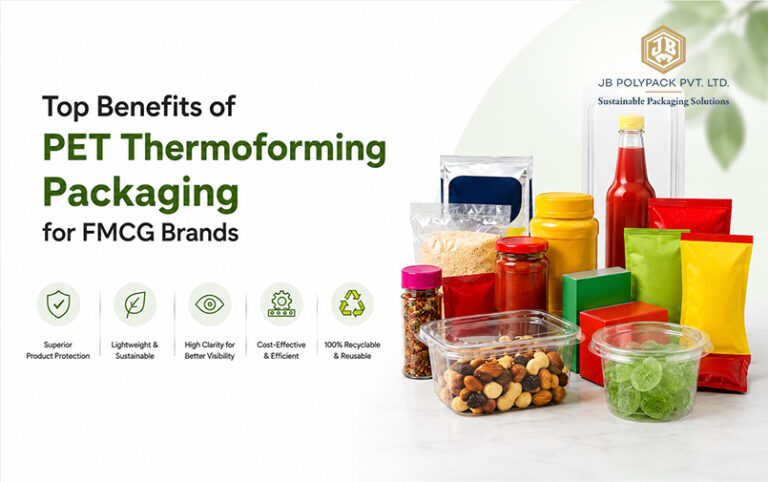
The packaging decision for an FMCG brand involves more stakeholders than most buyers account for. The procurement team owns cost per unit. The quality team owns food safety certification and migration compliance. The sustainability lead owns recycled content targets and EPR documentation. The retail and marketing team owns shelf visibility. The logistics team owns dimensional stability across cold-chain and ambient distribution. Each function has a different failure threshold, and the same packaging format has to pass all of them simultaneously.
PET thermoforming packaging has become the dominant rigid packaging format across FMCG categories precisely because it addresses all five concerns within a single material system. It delivers clarity that polypropylene cannot match at equivalent stiffness. It provides oxygen and moisture barrier performance that polystyrene cannot achieve. It is the most recycled plastic resin in India by collection volume, with rPET supply chains now operating under FSSAI-approved food-contact guidelines. For FMCG brands subject to India’s Plastic Waste Management Rules, rigid PET packaging offers a compliance-ready path to the 30% recycled content mandate that came into force for FY 2025-26, rising to 60% by FY 2028-29.
This is not a format decision driven by aesthetics. PET thermoforming packaging is a procurement decision with measurable performance outcomes across food safety, barrier chemistry, logistics durability, recyclability, and regulatory compliance. The sections below cover each of those dimensions with the technical specificity that specification decisions actually require. According to Global Market Insights, the global thermoform packaging market was valued at USD 50.3 billion in 2023 and is projected to reach USD 82.9 billion by 2032 at a CAGR of 5.7%, with PET consistently outperforming alternative materials on performance and sustainability metrics.
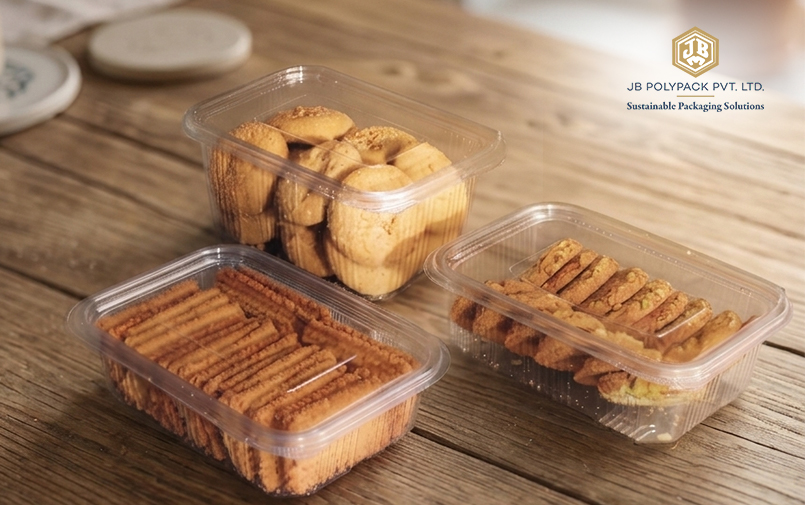
What Thermoformed PET Is, and Why the Grade Distinction Matters at Specification Stage
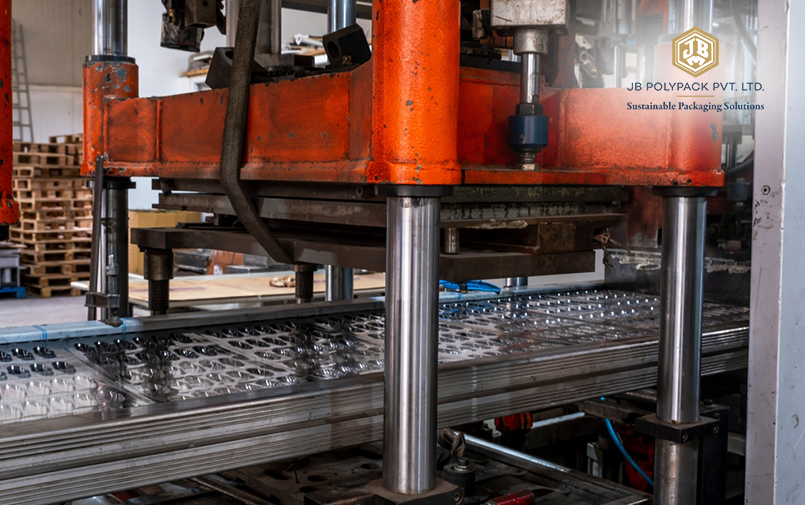
Thermoforming is a sheet-based conversion process. A PET sheet is heated to its softening point, typically between 80°C and 120°C for amorphous grades, then drawn over a mould using vacuum or positive pressure. The formed part is trimmed, stacked, and dispatched. The output, whether a punnet, a hinged clamshell, a tray, or a blister base, inherits its dimensional accuracy and wall consistency directly from the gauge uniformity of the input sheet and the process control precision during forming.
For FMCG applications, three material grades are commercially relevant:
APET (Amorphous Polyethylene Terephthalate) The standard thermoforming grade for ambient and chilled FMCG formats. High optical clarity, good stiffness-to-weight ratio, and excellent impact resistance across the temperature range of standard refrigerated distribution (0 to 8°C). Preferred for fresh produce, bakery, snacks, confectionery, and personal care formats where product visibility is a purchase trigger.
CPET (Crystalline Polyethylene Terephthalate) A partially crystalline structure achieved through controlled crystallisation during forming. Capable of withstanding temperatures up to 200°C, making it the appropriate grade for dual-ovenable meal trays and hot-fill food-service formats. Typically produced in black. Clarity is low by design; this grade trades transparency for thermal performance.
rPET (Recycled Polyethylene Terephthalate) APET or CPET manufactured from post-consumer PET feedstock, typically hot-washed, decontaminated flakes sourced from post-consumer PET bottles, reprocessed into food-contact grade resin through FSSAI-approved recycling methods. When produced through super-clean mechanical or chemical depolymerisation routes, rPET performs at material parity with virgin grades across standard FMCG thermoforming applications.
For most rigid FMCG packaging specifications, the active decision is between APET (virgin or rPET) and CPET. Misspecifying at this stage creates downstream compliance and performance problems. Dual-ovenable formats specified in APET will deform at elevated temperatures. Ambient snack formats specified in CPET will carry unnecessary opacity and cost without barrier benefit.
To understand how PET sheet thickness and clarity affect forming outcomes, the relationship between input sheet properties and finished container performance is covered in detail in JB Polypack’s guide on PET sheet specifications.
Barrier Performance: What PET Chemistry Delivers for Product Shelf Life
PET’s barrier properties are a direct consequence of its polymer chain structure. The ester linkage between ethylene glycol and terephthalic acid produces a dense matrix that restricts the diffusion of gases and moisture through the container wall. For FMCG buyers, three barrier properties matter in practice:
Moisture Vapour Transmission APET maintains a low moisture vapour transmission rate (MVTR) across standard ambient and refrigerated storage conditions. This is critical for bakery, confectionery, and dry snack formats where moisture ingress causes texture degradation, caking, or mould growth before the printed best-before date is reached. As explained in JB Polypack’s coverage of plastic packaging’s role in reducing food damage, barrier performance directly determines spoilage rates across FMCG distribution chains.
Oxygen Transmission APET’s oxygen transmission rate (OTR) is measurably lower than polypropylene at comparable gauge and significantly lower than polystyrene. For fat-containing products, including biscuits, nut-based snacks, and soft bakery items, oxygen exposure drives rancidity. For fresh-cut produce and ready-to-eat formats, oxygen ingress accelerates browning and microbial growth. PET thermoforms extend effective shelf life in these categories without requiring the addition of oxygen scavengers or modified atmosphere packaging in most ambient and short-shelf-life chilled applications.
Flavour and Aroma Barrier PET has very low affinity for aromatic compounds. It does not absorb product flavours into the container wall and does not transmit external odours into the packed product. This matters for personal care adjacent FMCG lines, dairy-adjacent formats, and any SKU packed in a mixed-category distribution environment.
Where extended shelf life is required, PET thermoforms accept standard barrier lidding films through heat-seal and peel-seal interfaces, enabling modified atmosphere packaging (MAP) configurations. The seal interface performance of APET with PET-compatible lidding films is well established across FMCG production lines globally.
The material comparison for FMCG rigid packaging procurement typically resolves to PET against PP and PS. PS offers good rigidity and clarity but poor oxygen barrier performance and very limited recyclability within India’s current collection infrastructure. PP offers adequate barrier and good chemical resistance but lower clarity and reduced cold-chain impact performance relative to APET. The PET case rests on three concurrent advantages: clarity, barrier, and end-of-life recyclability through an established domestic collection system.
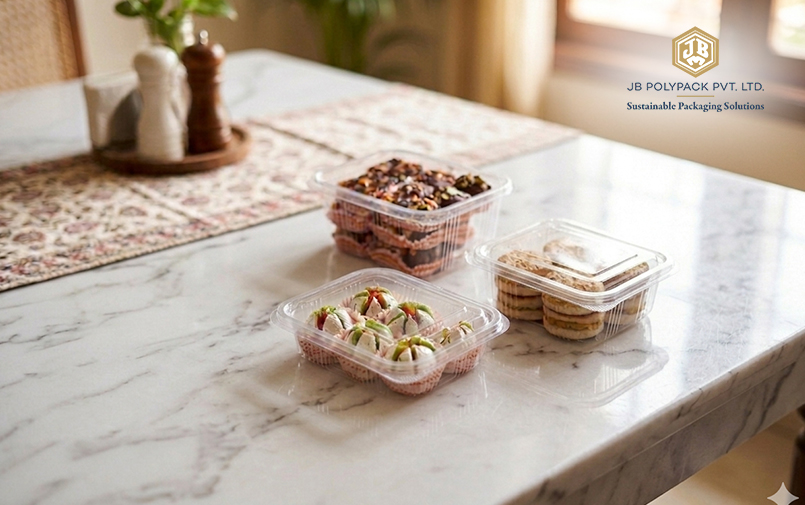
Optical Clarity: Why Transparent PET Packaging Is a Commercial Performance Variable
In self-service FMCG retail, the packaging makes the first argument for the product. There is no sales assistant, no sampling, and no secondary communication at point of decision. The buyer reads what they can see through the container, and for perishable and fresh categories, that visual assessment, colour, fill level, freshness, determines whether the product goes into the basket or back on the shelf.
Transparent PET packaging delivers this in a way that polypropylene and opaque carton formats cannot replicate. APET at standard FMCG gauges produces a crystal-clear finish that allows buyers to assess product condition before purchase. PP at equivalent stiffness carries visible milkiness that reads as lower quality in premium formats. CPET achieves no optical transparency by design.
From a commercial standpoint, this difference in clarity produces measurable outcomes:
• Higher shelf conversion rates in self-service retail environments where the product competes without sales assistance.
• Reduced return rates in fresh produce and bakery categories where product condition is a primary driver of consumer complaints.
• Improved product photography for e-commerce listings, reducing set-dressing and post-production costs for product teams.
• Stronger quality signals for premium-positioned SKUs in gifting, confectionery, and specialty food categories where perceived product integrity drives price acceptance.
Clarity is not a cosmetic specification variable. For FMCG brands in self-service retail and D2C channels, the transparency of the packaging directly affects sell-through rate and return incidence. This is also a key reason punnet box packaging in clear APET has displaced opaque and paper-based alternatives across fresh produce export formats.
Food-Grade Safety: FSSAI Compliance for Virgin APET and rPET in Thermoformed Containers
Food contact compliance for PET thermoforming operates across two axes: the material grade used and the recycling process applied to it.
Virgin APET compliance PET resin carrying resin identification code 1 (PET/PETE) is globally recognised as food-safe. In India, the Food Safety and Standards (Packaging) Regulations, 2018 govern permissible additives, migration limits, and processing requirements for food contact plastics. Compliant virgin APET thermoforms must demonstrate that migration of regulated substances into food simulants, including aqueous, acidic, alcoholic, and fatty simulants, remains within prescribed limits under standard test conditions.
rPET compliance in food contact applications FSSAI published comprehensive guidelines for the acceptance of recycled PET as a food contact material (FCM-rPET) in May 2025. These guidelines, which came into operational effect alongside the Food Safety and Standards (Packaging) Amendment Regulations published in the Official Gazette on 28 March 2025, establish the approved recycling processes and contamination thresholds for rPET used in food-contact packaging in India.
Four recycling processes are now approved under FSSAI guidelines for producing food-grade rPET:
• Super-Clean Recycling Process: Conventional mechanical recycling enhanced with an integrated decontamination step using surface treatment, high heat, and/or high vacuum in a controlled environment.
• Melt-In Recycling Process: Post-consumer rPET introduced into a melt stream with controlled thermal decontamination.
• Paste-In Recycling Process: Recycled PET flake introduced into a paste tank where partial glycolysis provides decontamination.
• Enhanced Chemical Recycling Process: Full depolymerisation of PET back to its monomers, ethylene glycol and terephthalic acid, followed by re-polymerisation. This route produces material chemically identical to virgin PET and is treated as equivalent to virgin PET under FSSAI guidelines. (Source: FSSAI Guidelines for Recycling of Post-Consumer PET for Food Contact Applications; Packaging Law, 2022.)
All approved processes must demonstrate that residual surrogate contaminants in the rPET resin are reduced to below 220 micrograms per kilogram, aligned with USFDA benchmarks, or that migration into food simulating solvents remains below 10 micrograms per kilogram, aligned with EU EFSA benchmarks.
Conventional mechanical recycling without a dedicated decontamination step does not qualify under FSSAI guidelines for food-contact use. FMCG buyers should confirm the specific recycling route used for any rPET thermoformed packaging they specify.
The practical procurement checklist for rPET thermoformed containers in food-contact applications:
• Request the FSSAI approval documentation for the rPET resin supplier and confirm the approved process type.
• Verify that the rPET feedstock originates exclusively from food-packaging-grade post-consumer PET, meaning beverage and food bottles, not chemical or detergent containers.
• Obtain batch-specific migration test reports, particularly for fatty food simulants for oil-containing product formats.
• Confirm that no post-forming additives such as colourants or slip agents compromise the recyclability of the finished container.
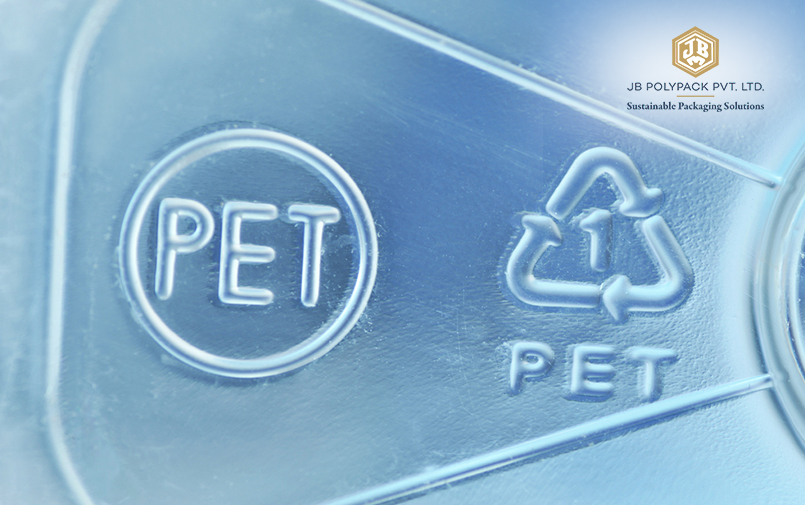
rPET and Recycled Packaging: The Circular Loop That Now Has Regulatory Backing
The case for rPET thermoforming has historically been positioned as a sustainability preference. Since 2025, it has become a compliance requirement with financial consequences for non-compliance.
India’s Plastic Waste Management Rules: Current Recycled Content Targets
India’s Plastic Waste Management (Amendment) Rules, updated progressively since the EPR framework was notified in February 2022 by the Ministry of Environment, Forest and Climate Change, now carry mandatory recycled content targets for rigid plastic packaging (Category I). The phased schedule for minimum recycled content in rigid plastic packaging is:
• FY 2025-26: 30% minimum recycled content
• FY 2026-27: 40% minimum recycled content
• FY 2027-28: 50% minimum recycled content
• FY 2028-29 onwards: 60% minimum recycled content
These are enforceable obligations on Producers, Importers, and Brand Owners (PIBOs). Non-compliance penalties range from INR 10,000 to INR 15 lakh per violation, with the possibility of daily penalties and permit suspension for persistent non-compliance. Additionally, from January 2025, all plastic packaging must carry traceable QR codes, barcodes, or unique identifiers per CPCB amendment requirements, making recycled content claims auditable.
What rPET Thermoformed PET Packaging Enables for EPR Compliance
For FMCG brands in the rigid packaging category, rPET thermoformed PET containers provide a direct route to meeting the recycled content mandate. The key requirements for this to function as documented EPR compliance evidence are:
• The rPET resin must be sourced from a supplier holding a current GRS (Global Recycled Standard) scope certificate or equivalent third-party certification that verifies recycled content claims.
• The recycling process must be FSSAI-approved for food-contact applications if the container is used in direct food contact.
• The recycled content percentage must be documented per batch with traceable certification to support EPR portal reporting on the CPCB platform.
GRS certification tracks and verifies recycled content through the supply chain from post-consumer collection to finished product. For FMCG buyers submitting EPR recycled content compliance reports to the CPCB portal, GRS-certified rPET procurement documentation provides the auditable trail that self-reported recycled content claims cannot.
Mechanical rPET versus Chemically Recycled rPET: The Distinction That Affects Specification
Mechanical rPET is produced by collecting, sorting, washing, and reprocessing post-consumer PET through a super-clean decontamination route that retains the polymer backbone. Intrinsic viscosity (IV) and some optical properties can vary across batches depending on feedstock consistency. For cost-sensitive FMCG formats where GRS-certified supply is available, mechanical rPET is a commercially viable and FSSAI-compliant route to meeting the recycled content mandate.
Chemically recycled rPET involves full depolymerisation of post-consumer PET back to its constituent monomers before re-polymerisation under controlled conditions. The output is chemically indistinguishable from virgin PET in terms of IV, clarity, and contamination profile. Under both FSSAI and EFSA frameworks, chemically recycled PET is treated as equivalent to virgin material and carries no challenge testing obligation specific to the recycling route. For premium FMCG formats where rPET clarity and batch consistency are critical, such as fresh produce, confectionery, and personal care, chemically recycled rPET is the grade that eliminates material performance variability as a concern.
For background on how PET flakes feed into this recycling chain, JB Polypack’s coverage of PET flakes in the circular economy explains the upstream material flow from post-consumer collection to reprocessed resin.
Recyclability of PET Thermoformed Containers at End of Life
PET carries resin identification code 1, the most widely collected and recycled resin in India’s post-consumer collection system. The infrastructure for PET collection and sorting exists at scale because of decades of PET bottle recycling activity. Thermoformed PET containers, including clamshells and punnets, enter the same PET collection stream. JB Polypack’s article on how recycled plastic punnets support sustainable packaging covers how rPET punnet formats perform within this collection and reprocessing loop.
FMCG buyers designing for genuine end-of-life recyclability should specify mono-material APET or rPET containers without opaque colourants, metallised barrier layers, or incompatible label adhesives. These additions contaminate the clear PET recycling stream and reduce the yield of sortable rPET flake from post-consumer collection. Clear, single-material PET thermoforms with PET-compatible labels are the specification that closes the circular loop most reliably.
Structural Performance Through the FMCG Distribution Chain
A thermoformed PET container in FMCG distribution moves through a predictable mechanical sequence. Each stage creates a different failure mode, and the material specification needs to account for all of them.
At production line speeds (60 to 120 packs per minute) APET thermoforms produced from uniform-gauge extruded sheet hold tighter dimensional tolerances than injection-moulded alternatives for high-speed automated packaging applications. The forming process distributes material across the mould cavity with controlled wall thickness variation, producing consistent geometry that automated lidding and sealing equipment handles reliably across a production run.
In cold-chain distribution (0 to 8°C) PET retains its impact resistance through standard refrigeration temperatures. PP becomes progressively more brittle below 5°C, increasing drop-damage risk for chilled SKUs. For fresh-cut fruit, salad greens, and fresh-packaged berries and grapes, and ready-to-eat proteins distributed in chilled logistics, this cold-temperature performance differential is a material specification consideration.
Under retail stacking load For hinged clamshell formats in FMCG ambient and chilled categories, APET at 300 to 500 micron gauge provides adequate stiffness to sustain the compressive load of stacked retail units without collapsing or splitting. Thinner gauges of 200 to 250 microns are appropriate for lightweight confectionery and dry snack formats where unit loads are low.
In India’s warm ambient distribution (up to 40 to 45°C) APET has a glass transition temperature (Tg) of approximately 75°C, well above the maximum ambient temperatures encountered in standard Indian FMCG distribution. Dimensional stability is maintained through standard ambient storage conditions. For formats placed near heat sources such as display lighting or in close proximity to bakery operations, CPET is the appropriate grade specification.
APET, PP, and PS for FMCG Thermoforming: A Properties Comparison
Procurement decisions require direct material comparisons. The property assessments below are indicative, based on general industry data and JB Polypack’s production experience. Actual performance varies by specific resin grade, gauge, and application conditions. Request material data sheets from your supplier for specification-grade decisions.
APET (Virgin or rPET)
• Optical clarity (haze): Very high, typically below 5% at standard FMCG gauges
• Oxygen barrier (OTR): Strong barrier, lower OTR than PP and PS at equivalent gauge
• Moisture vapour barrier: Good across ambient and refrigerated conditions
• Impact resistance at ambient: High
• Impact resistance at chilled (0 to 5°C): High, retains performance unlike PP
• Recyclability in India: High; resin code 1 with established collection infrastructure
• Food-grade rPET availability: Yes, FSSAI-approved route defined as of May 2025
• EPR recycled content documentation: GRS-certified rPET supply available
• Dual-ovenable capability: Available via CPET grade
• Typical FMCG gauge range: 200 to 500 microns
PP (Polypropylene)
• Optical clarity (haze): Moderate, typically 10 to 20% at equivalent gauge
• Oxygen barrier (OTR): Moderate
• Moisture vapour barrier: Good
• Impact resistance at ambient: High
• Impact resistance at chilled (0 to 5°C): Reduced; brittleness increases below 5°C
• Recyclability in India: Moderate; resin code 5 with limited collection infrastructure relative to PET
• Food-grade rPET availability: Limited certified supply
• EPR recycled content documentation: Limited certified supply chain available
• Dual-ovenable capability: Via specific PPCT variants
• Typical FMCG gauge range: 200 to 600 microns
PS (Polystyrene)
• Optical clarity (haze): High, below 5%, comparable to APET
• Oxygen barrier (OTR): Poor
• Moisture vapour barrier: Moderate
• Impact resistance at ambient: Moderate
• Impact resistance at chilled (0 to 5°C): Low; brittle at refrigerated temperatures
• Recyclability in India: Low; limited collection and reprocessing infrastructure
• Food-grade rPET availability: Not commercially applicable
• EPR recycled content documentation: Not commercially applicable
• Dual-ovenable capability: No
• Typical FMCG gauge range: 200 to 400 microns
These are directional comparisons. OTR and MVTR values depend on resin grade, gauge, crystallinity, and any additional barrier coatings. Request certified test data from your supplier before finalising food-contact specifications.
Design Flexibility and Commercial Viability of Thermoforming vs. Injection Moulding
Thermoforming and injection moulding are both used to produce rigid food containers, but they serve different commercial production contexts. Understanding the difference helps FMCG procurement and packaging teams avoid over-specifying or under-specifying formats.
Injection moulding produces thick-walled, high-strength parts with tooling costs that can range from INR 5 lakh to over INR 25 lakh depending on complexity and cavity count. The economics require high minimum order quantities to amortise that tooling investment.
Thermoforming uses aluminium tooling at substantially lower cost per mould, making it commercially viable at lower annual volumes and enabling new format development in weeks rather than the three to six month tooling cycle of injection moulding. For FMCG brands, this has direct commercial implications:
• New SKU and seasonal format development: Thermoformed formats can be prototyped, sampled, and taken to production within timeframes compatible with FMCG promotional calendars and retailer ranging cycles.
• Multi-cavity production: A single thermoforming die can run multiple cavity configurations in a single production shift, allowing different pack sizes to be produced on the same equipment run.
• Embossing and brand detail: APET accepts fine surface embossing. Brand logos, texture patterns, and code-compliant text can be incorporated directly into the mould without secondary decoration steps.
• Precision dimensional specification: For FMCG formats with fill weight targets such as 100g, 250g, or 500g, thermoformed containers can be dimensioned to fill target with high repeatability, reducing product give-away and improving retail weight compliance.
The genuine limitation of thermoforming relative to injection moulding is sidewall thickness consistency on deep-draw, high-aspect-ratio geometries. Deep cavities with complex undercuts require experienced tooling design and process control to maintain adequate material distribution at sidewalls. This is an engineering constraint that experienced thermoformers manage through tooling geometry and forming process parameters.
For a fuller explanation of how thermoforming works as a manufacturing process, JB Polypack’s introduction to thermoforming products and processes covers the production methodology in accessible detail. For an understanding of the range of applications that thermoformed formats can serve beyond the obvious FMCG categories, the piece on non-obvious thermoforming applications for hinged box formats is worth reading before finalising a packaging brief.
About JB Polypack: Thermoformed PET Packaging from an Integrated rPET Supply Chain
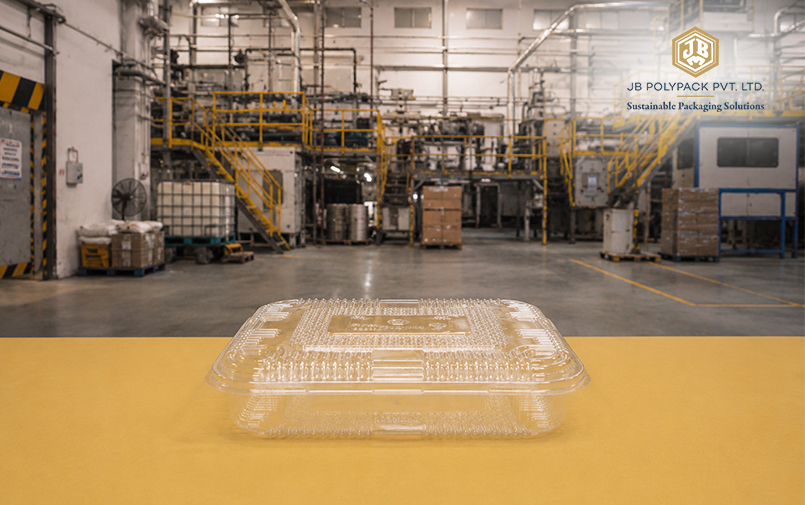
JB Polypack Pvt. Ltd. manufactures thermoformed PET packaging, principally punnet boxes and hinged clamshell containers, from APET and rPET sheet. JB Polypack is part of the Jay Bharat Group, operating from Surat, Gujarat since 1985, with a supply chain that spans PET bottle collection, recycling, rigid sheet manufacturing, and thermoformed container production.
JB Polypack holds GRS scope certificates and INFM certification. Details on certifications are available on the JB Polypack certifications page.
For FMCG buyers, this supply structure provides:
• Traceability: The rPET content in JB Polypack thermoformed containers is traceable to post-consumer PET bottle collection and recycling through GRS certification documentation, providing the auditable trail required for CPCB EPR portal reporting.
• FSSAI compliance documentation: Food-safety documentation for rPET resin is available for procurement and quality teams specifying food-contact thermoformed containers.
• Custom format development: Punnet boxes and hinged clamshell containers are available in virgin APET and GRS-certified rPET grades across standard FMCG gauge ranges, with custom cavity dimensions for brand-specific formats.
• Sustainability documentation: JB Polypack’s sustainability commitments and circular packaging approach are outlined on the sustainability page.
Frequently Asked Questions
What is PET thermoforming packaging?
Thermoformed PET packaging is rigid packaging produced by heating a PET sheet to its forming temperature, drawing it over a mould using vacuum or pressure, and trimming the formed part to specification. Common FMCG formats include punnet boxes, hinged clamshell containers, trays, and blister bases. The input sheet is typically APET for ambient and chilled applications, CPET for high-temperature or dual-ovenable applications, and rPET for formats requiring verified recycled content.
Can rPET thermoformed containers be used for direct food contact in India?
Yes, subject to compliance with FSSAI’s guidelines for food-grade rPET (FCM-rPET). The rPET resin must be produced through an FSSAI-approved process, specifically Super-Clean, Melt-In, Paste-In, or Chemical Recycling, and must demonstrate decontamination to the prescribed residual contaminant thresholds. Conventional mechanical recycling without an integrated decontamination step does not qualify. Buyers should request the rPET supplier’s FSSAI approval documentation and batch-specific migration test reports before specifying for food-contact applications.
What is the difference between mechanical rPET and chemically recycled rPET? Mechanical rPET is produced by collecting, sorting, washing, and reprocessing post-consumer PET through a super-clean decontamination route that retains the polymer backbone. Chemically recycled rPET involves full depolymerisation of post-consumer PET back to its monomers before re-polymerisation, producing material chemically equivalent to virgin PET. FSSAI treats chemically recycled PET as equivalent to virgin for compliance purposes. Both routes are FSSAI-approved. Chemically recycled rPET offers greater batch consistency and clarity for premium applications. FSSAI-compliant mechanically recycled rPET via the super-clean process is the more widely available and cost-effective route for standard FMCG formats.
What recycled content target applies to rigid plastic packaging under India’s EPR rules?
Under the Plastic Waste Management Rules as amended through 2026, rigid plastic packaging (Category I) must contain a minimum of 30% recycled content in FY 2025-26, rising to 40% in FY 2026-27, 50% in FY 2027-28, and 60% from FY 2028-29 onwards. GRS-certified rPET procurement provides the documentary evidence required for EPR recycled content compliance reporting on the CPCB portal.
How does PET thermoforming perform across India’s ambient and cold-chain distribution conditions?
APET has a glass transition temperature of approximately 75°C, well above the maximum ambient temperatures in Indian logistics corridors. Dimensional stability is maintained through ambient storage conditions. In cold-chain distribution at 0 to 8°C, APET retains impact resistance and geometry where PP becomes more brittle. For formats in proximity to heat sources or in hot-fill applications, CPET is the appropriate grade.
What certifications should be requested when sourcing thermoformed PET packaging?
For food safety in rPET applications: FSSAI approval documentation for the rPET resin supplier, specifying the approved recycling process type and batch-specific contamination and migration test reports. For recycled content: GRS scope certificate from both the rPET resin supplier and the thermoformer. For EPR compliance reporting: GRS documentation to support recycled content declarations on the CPCB EPR portal. For general quality: ISO 9001:2015 for the manufacturing entity. JB Polypack’s current certifications are listed on the certifications page.