PET Sheet Applications Beyond Packaging: Emerging Industrial Uses
When a fabrication shop calls us, they rarely ask about packaging. The call usually starts with a part: a machine guard that keeps cracking under impact, a signage panel that yellows after six months outdoors, a clear barrier that needs to survive a factory floor instead of a retail shelf. We supply PET sheet for packaging every day, but a growing share of our enquiries have nothing to do with packaging at all.
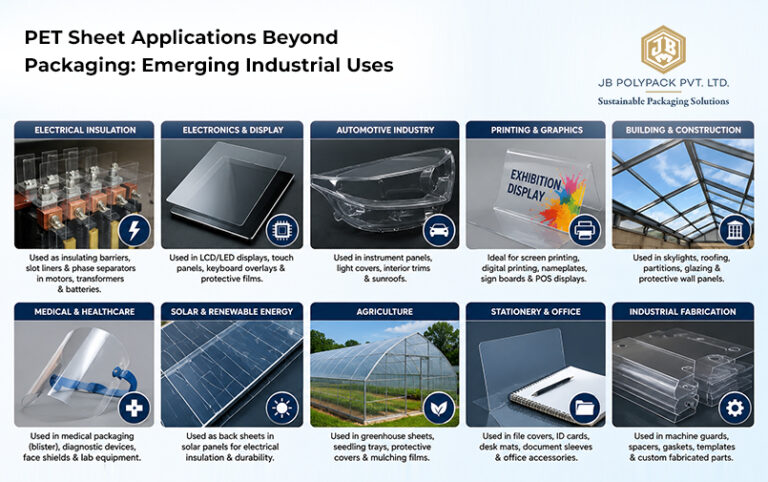
PET sheet has spent decades being talked about almost exclusively as a packaging material: food trays, blister packs, bottle-grade resin. That reputation is accurate but incomplete. The same base polymer, run at industrial gauge and matched to the right fabrication process, shows up in machine guarding, signage, construction glazing, automotive interior components, and electrical insulation parts, work that has nothing to do with holding or protecting a consumable product.
We get asked about these non-packaging jobs often enough that we think it is worth setting out, plainly, where PET sheet genuinely fits outside packaging, where it does not, and what we tell buyers to check before they commit to it for an industrial part.
Why PET Sheet Moved Past Packaging
PET, or polyethylene terephthalate, was never selected for packaging because it was the only option. It was selected because it offered a specific combination: high clarity, good impact resistance, dimensional stability, and a forming process that scales well. None of those properties are packaging-specific. A machine guard needs impact resistance just as much as a blister pack does. A signage panel needs clarity just as much as a food tray.
What has changed is awareness. Fabricators who spent years defaulting to acrylic or polycarbonate for clear industrial parts are increasingly looking at PET sheet because of cost, recyclability, and the fact that rPET grades let them meet sustainability requirements that acrylic cannot match as easily. PET’s suitability for demanding technical roles is not just a supplier talking point either, as the electrical insulation section below shows.
Machine Guards And Protective Covers
Industrial machine guarding is one of the clearest non-packaging fits for PET sheet. Manufacturing floors need clear or semi-clear barriers around moving parts, cutting heads, and conveyors so operators can see the process without being exposed to it. PET sheet in industrial gauge thickness handles this because it resists cracking under repeated impact better than more brittle clear plastics, and it can be cut, drilled, and bent into mounting brackets without specialized tooling.
This is a fabrication-led market, not a packaging one. When a machine builder or maintenance team calls us about guarding, the questions are rarely about clarity or shelf appeal. They ask about:
– Edge finishing after cutting, since a rough edge on a guard panel is a handling hazard
– Mounting hole tolerance, because guards get drilled on site and need to hold their shape under repeated drilling and bolting
– How the sheet behaves when it is removed and reinstalled repeatedly for servicing, since guards come off far more often than packaging gets reopened
– Impact behavior at the panel’s actual in-service thickness, not at a thinner packaging gauge
None of that overlaps with how a packaging buyer evaluates the same base material, which is exactly why we treat it as a separate conversation rather than folding it into a standard packaging quote.
Signage, Lightboxes, And Display Panels
Signage is one of the oldest non-packaging uses of PET sheet, and it remains one of the largest by volume. The optical clarity that makes PET useful in food packaging is the same property a sign fabricator is buying, but the performance demands are different. A sign panel needs to hold its clarity and color stability outdoors for years, not survive a single retail display cycle.
In practice, this category covers:
– Outdoor signage panels and shop fascia boards
– Illuminated lightboxes, where light transmission consistency across the sheet matters as much as clarity
– Exhibition and trade show display panels
– Point-of-sale display structures built for repeated assembly and disassembly
Printability matters here in a way it rarely does in packaging. PET sheet takes screen printing and UV printing cleanly, which is why sign fabricators favor it over more flexible plastics that distort under print pressure or heat curing. When we quote sheet for this kind of order, the variable we are watching most closely is flatness and surface finish consistency, because a sign panel with visible waviness or an inconsistent print surface is a rejected job, not a minor cosmetic issue.
Construction And Architectural Glazing
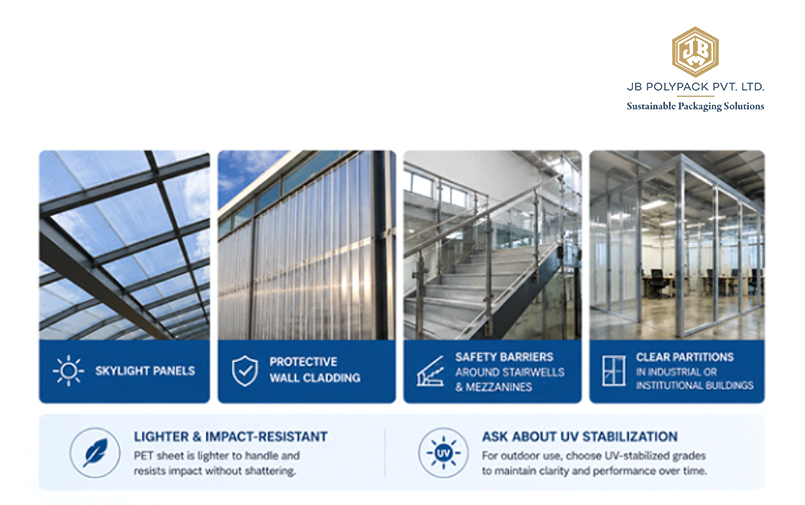
PET sheet is used as a lighter, more impact-resistant alternative to glass in several construction applications. The appeal is straightforward. Glass breaks into sharp fragments and is heavy to install at height. PET sheet at the right thickness resists impact without that failure mode, and it is far easier to cut and fit on site. Common uses include:
– Skylight panels
– Protective wall cladding
– Safety barriers around stairwells and mezzanines
– Clear partitions in industrial or institutional buildings
This is also where we push back most on buyers who assume the material is a drop-in glass replacement. PET sheet is not a structural glazing solution in every climate or load condition, and UV exposure over years can affect clarity and surface integrity depending on the specific grade and any UV-stabilizing treatment. If a contractor asks us for PET sheet for an outdoor application, we ask in return whether the grade needs UV stabilization, because a sheet optimized for indoor signage is not automatically suited to years of direct sun exposure on a rooftop.
Automotive Interior Components
Automotive manufacturers use PET sheet for interior parts where toughness, dimensional stability, and weight savings matter more than load-bearing strength. This shows up in:
– Interior trim panels
– Instrument cluster covers
– Protective shielding around components that need to stay visible but covered
The fit comes from PET’s combination of impact resistance and low weight relative to alternatives, which matters directly to a vehicle’s overall weight budget. It does not mean we treat PET sheet as interchangeable with the engineering-grade plastics used in load-bearing automotive parts. Heat exposure near engine components, long-term UV exposure on exterior-facing trim, and impact ratings required by automotive safety standards all narrow down which PET grade, if any, is actually suitable for a specific part. We tell automotive buyers the same thing every time: this is a part-by-part conversation, not a “PET sheet works in cars” conversation.
Electrical Insulation And Component Housings
PET’s role in electrical insulation is not a supplier claim. It is governed by a published international standard. IEC 60674-3-2, maintained by the International Electrotechnical Commission, sets out the requirements for balanced biaxially oriented PET films used for electrical insulation. That standard applies to PET in thin film form, well below the gauge we supply as rigid sheet, so it is best read as confirmation that PET as a polymer family has long-established, codified electrical insulation properties, not as a specification for the thicker industrial sheet covered elsewhere in this article.
At the thicker gauges relevant to sheet fabrication, PET shows up in:
– Insulating components inside electrical assemblies
– Panel housings for equipment enclosures
– Protective covers around electronic devices, where dielectric properties and dimensional stability under handling matter more than appearance
This is a precision-driven market, and we treat it differently from a display or signage enquiry. Tolerance on thickness and consistency in performance across a batch matter far more here, because a failure in an electrical insulation part is a safety issue, not a cosmetic one. We expect buyers in this space to ask us for test data and tolerance specifications tied to the exact grade being supplied, and we would be concerned about any supplier who answers that request with general material claims instead.
Mechanical And Wear-Resistant Parts
A smaller but real category of non-packaging PET sheet use involves mechanical wear parts: guide components, spacers, and wear pads in equipment that benefits from a tough, low-friction, chemically resistant plastic instead of metal. This is a niche request compared to signage or machine guarding enquiries, but it makes the underlying point clearly. The same sheet we run for fresh food packaging can, at the right gauge and grade, become a functional mechanical component in an entirely different industry.
Why These Uses Sit Outside Our Packaging Product Line
We want to be direct about a distinction that matters if you are doing real diligence on us or any other supplier. Our rigid PET sheets line is built and specified around APET and rPET grades in the 0.25mm to 3.0mm thickness range, and our published applications center on packaging, thermoforming, and the food-contact and industrial-strength use cases that range typically serves. Everything we have described above is where PET sheet as a material category is genuinely capable. It is not a claim that every one of these jobs is something we are running at production scale today.
We say this because the worst outcome for a buyer is choosing a supplier on a generic capability claim, then finding out mid-project that the actual grade, thickness, or finish their part needs falls outside what that supplier stocks or can produce reliably. We would rather tell a buyer upfront which of these applications fall inside our current production scope and which would need to be scoped and tested first, even if that means losing the enquiry to someone overstating what they can deliver. A PET sheet manufacturer worth working with on a non-packaging job should be willing to do the same.
How To Evaluate PET Sheet For A Non-Packaging Application
The evaluation process for an industrial, non-packaging job looks different from a packaging procurement process, and conflating the two is where buyers run into trouble. When we walk a buyer through this, we tell them to:
– Define the part’s actual operating environment first, not just its shape. Indoor signage and outdoor glazing both might look like “clear PET sheet panels” on a spec sheet, but UV exposure, temperature range, and impact load are completely different between them.
– Confirm whether the application needs APET, rPET, or a different PET-family material entirely. Some non-packaging jobs, particularly heavy fabrication and machine guarding, are more commonly served by PETG, a glycol-modified variant with different fabrication behaviour than standard APET or rPET. We will tell a buyer directly if their job is better suited to PETG than to what we supply.
– Ask for thickness tolerance and flatness specifications relevant to the part, not generic sheet specifications. A sign panel and an electrical insulation component have very different tolerance requirements, even at similar nominal thickness.
– Request test data or sample sheets before committing to production volume, especially for any application involving outdoor exposure, electrical performance, or mechanical load. Verbal assurances about material performance are not a substitute for testing the actual grade against the actual use condition.
– Ask the supplier directly whether the application falls within their current production scope or would require process validation. A capable supplier should be willing to draw that line clearly rather than agreeing to every request.
The Procurement Angle Most Buyers Miss
There is a cost dimension to this that rarely comes up until a buyer has already committed to a material, and it is one we walk new non-packaging customers through early. Industrial PET sheet sold for fabrication work is often priced and ordered differently than packaging-grade sheet, even when the underlying resin is similar. Packaging buyers typically order in volumes and standard formats tied to thermoforming lines built around specific tray or punnet dimensions. A signage fabricator or machine shop ordering the same material is usually working in cut sheets, custom widths, or smaller batch sizes built around a part drawing rather than a packaging mold.
This affects lead time and minimum order quantity more than it affects the per-kilogram price of the resin itself. A supplier set up primarily for high-volume packaging runs may not be the most efficient source for a one-off batch of custom-cut sheet for a machine guarding job, even if they technically stock the right grade. We tell buyers evaluating any supplier for non-packaging work, including us, to ask directly about cut-sheet capability, minimum order size for custom dimensions, and typical turnaround for fabrication-oriented orders, since these operational details often matter more to project timelines than the headline material specification.
Recycled content adds another layer. rPET sheet is frequently positioned as a sustainability upgrade, and for many non-packaging applications, it genuinely is one, since the mechanical performance gap between virgin and recycled PET sheet has narrowed considerably for general fabrication use. But if you are specifying rPET for a job with strict optical or dielectric requirements, confirm that the specific rPET grade on offer has been validated for that requirement. Do not assume all rPET sheet performs identically simply because it shares a name with packaging-grade rPET, including ours.
What This Means For Industrial Buyers
The broader shift here is straightforward, and it is one we see in our own enquiry pipeline. PET sheet’s reputation as a packaging material was earned, but it was never a ceiling on what the material can do. Fabricators, sign shops, electrical component makers, and automotive interior suppliers are increasingly treating PET sheet as a serious option for jobs that have nothing to do with holding a product on a shelf.
If you are evaluating this material for the first time outside a packaging context, our advice is to treat the application, not the material name, as the starting point. PET sheet covers a wide enough range of grades and thicknesses that “does PET sheet work for this” is rarely a yes or no question. The better question is which grade, gauge, and finish actually fits the part you are building, and whether the supplier you are talking to can speak to that specifically rather than in general material terms.
If you are scoping a non-packaging application and want to know whether it fits within our current PET sheet manufacturing capability, reach out directly with the part’s operating conditions and we will tell you plainly whether it is a fit or whether it needs further validation.
Frequently Asked Questions
Is PET sheet used outside of packaging?
Yes. PET sheet is used in machine guards, signage, construction glazing, automotive interior trim, and electrical insulation parts, where its clarity, impact resistance, and dimensional stability matter independently of any packaging function.
Can PET sheet replace glass in industrial or construction settings?
PET sheet can replace glass in some glazing and barrier applications because it resists impact better and weighs less. It is not a universal substitute, and suitability depends on the specific load, climate, and UV exposure conditions of the application.
What is the difference between PET sheet and PETG sheet for industrial use?
PET sheet and PETG, a glycol-modified variant, behave differently during fabrication. PETG is generally easier to thermoform and machine for heavy fabrication work like guards and covers, while standard PET and rPET sheet are more commonly specified for packaging-adjacent and electrical applications.
Is recycled PET sheet suitable for industrial, non-packaging applications?
rPET sheet can be suitable for many industrial applications if the recycled content, clarity, and mechanical performance match the job’s requirements. Buyers should confirm these specifications directly with the supplier rather than assuming all rPET grades perform identically.
How do I know if a PET sheet is the right material for my specific industrial part?
Start with the part’s operating environment, including temperature, UV exposure, and impact load, then confirm thickness tolerance and grade with your supplier. A supplier who can speak to your exact application, rather than general material claims, is the better indicator of fit.