How to Choose PET Strapping Without Over-Specifying Your Packaging
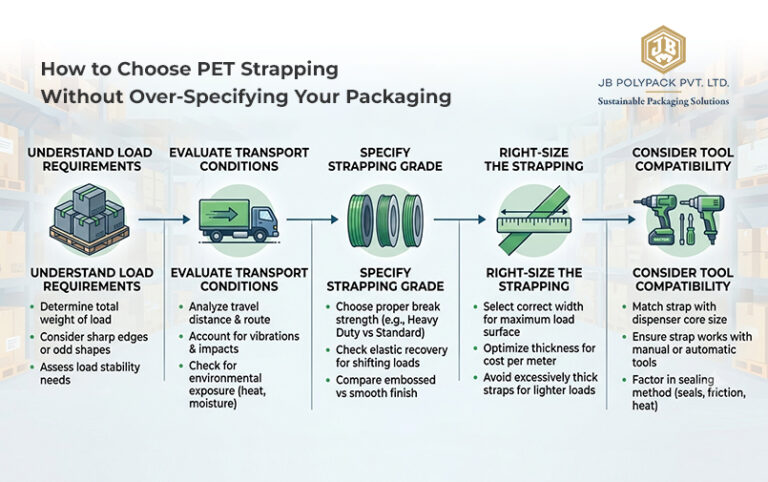
Buyers rarely ask us what a load needs. They ask for the strongest grade available, and they ask it because nobody has given them a reason to ask anything else.
That instinct is understandable. It is also expensive, because in strapping procurement the strongest grade and the correct grade are seldom the same product, and the gap between them repeats on every order for as long as the specification goes unexamined.
What follows is the reasoning we walk buyers through before quoting PET strapping, drawn from published industry guidance rather than from any single supplier’s product claims.
Over-Specification Is an Arithmetic Problem
The most common cause of over-specified PET strap is a single safety margin applied across every load in a plant.
That approach fails because the ratio of strap break strength to load weight is not constant. It changes according to what the strap is being asked to do, and published guidance treats the three main jobs as separate calculations.
PAC Strapping Products sets out starting ratios for each:
-Carton reinforcement, where the box is already providing containment and the strap supports it, works from a 3 to 1 ratio of total strap break strength to package weight.
-Palletised cases use pallet weight multiplied by 1.5, divided by the number of straps applied, to give the break strength required per strap.
-Unitizing and bundling, where the strap itself is the package and no carton is doing any work, works from a 5 to 1 ratio.
The spread between the lightest and heaviest of these is substantial. An operation that applies the bundling ratio to palletised cartons is working from a figure several times higher than that application calls for.
PAC is clear that these are starting points rather than final specifications, and that handling characteristics, intended use, and load behaviour all move the result, with long-distance shipments in adverse conditions requiring additional margin.
The Divisor Most Buyers Forget
Inside the palletised formula sits the step that gets dropped most often. The ratio produces a total break strength requirement across the whole load, which is then divided by the number of straps applied.
Pass count therefore changes the per-strap requirement directly. The same pallet, strapped with four passes or with six, produces two different PET strap load capacity figures, and those figures may sit at different points in a supplier’s range.
This is why a quote based on width alone tends to come back high. Without pass count, a supplier has no way to run the division, and quoting upward is the only safe response.
The Joint Sets the Ceiling on Any Upgrade
Break strength is a property of the strap. It is not what reaches the load, because a strapped load fails at its closure long before it fails in the span.
Joint efficiency describes the proportion of break strength that survives at the joint. Packaging Technology Today reports that manual tools using a seal or wire buckle typically achieve around 60%, while battery-powered friction weld tools reach roughly 85%. Fromm Packaging treats anything above 75% of break strength as an efficient seal joint.
The consequence for a purchasing decision is worth sitting with. Any gain from moving up a grade is scaled down by whatever proportion the closure retains. Where the closure is weak, most of a grade upgrade is absorbed before it reaches the load, while the same spend directed at tooling raises the performance of every roll already in the warehouse rather than only the rolls yet to be ordered.
PAC states the principle directly, noting that investment in tooling and machinery increases tension capability, consistency, and joint efficiency while reducing the cost of closures, waste, and labour.
Thickness Is Not a Reliable Proxy for Strength
PET strap thickness is the specification buyers place most weight on in a quote comparison, and on embossed product it carries less information than it appears to.
PAC describes thickness on embossed strapping as a nebulous measurement, since the embossing pattern contributes to the caliper reading. Their guidance goes further, noting that an over-embossed strap will measure a greater thickness while its break strength will be lower.
Read alongside a procurement process that compares suppliers on stated thickness, that creates a real risk of selecting the weaker product on the belief that a higher number indicates a stronger one.
The practical response:
–Ask for break strength stated against the specific width and gauge combination being quoted, not against width alone.
–Treat thickness as a dimensional question about whether the strap fits the machine track, rather than as an indicator of PET strap tensile strength.
–Establish whether a quoted figure is a typical value or a minimum guaranteed value, since the two are not comparable across suppliers.
PET Strap Grades Describe Tolerance, Not a Strength Ladder
The word grade causes persistent confusion in strapping procurement, because buyers hear a ranking of strength where the industry is describing manufacturing tolerance and intended application method.
PAC separates plastic strapping into three:
-Hand grade, designed for application by hand or with manual, battery-powered, or pneumatic tools.
-Semi-automatic grade, which lacks the stiffness that full track machines require while running well on archless semi-automatic machines.
-Machine grade, manufactured under closer tolerances with minimal camber, meaning the twist or curve in the strap.
Camber is the pivot. PAC notes it is not a significant factor in manually applied strapping, and that machine grade must be relatively camber free to travel through a machine’s arch.
The cost runs in both directions. Specifying machine grade for a manual line buys dimensional tolerance the application cannot use. Ordering hand grade for an automatic line to save on unit price tends to return the saving several times over in feed problems and downtime.

What the Strap Does in Service
Two properties describe strapping behaviour under load, and neither is break strength.
Elongation is the stretch that occurs as tension is applied. PAC notes that it is generally expressed within the working range, which they define as 40% to 60% of ultimate break strength. A datasheet elongation figure therefore describes behaviour at working tension rather than at the point of failure, which is a distinction worth understanding before comparing figures across suppliers.
Creep is the loss of retained tension over time, described by PAC as tension decay. A load that is correctly tensioned at dispatch and arrives slack, with no strap broken, has experienced creep rather than a strength failure. PAC rates polyester as holding the highest retained tension among non-metallic strapping materials when properly applied, which is the technical reason PET replaced polypropylene across much medium and heavy duty work.
The diagnostic point matters more than the definitions. Where loads arrive loose without a broken strap, break strength is not the variable in play, and a heavier specification will not correct it.
Where the Saved Money Usually Belongs
When a specification comes down, the difference generally has a more productive home in the same operation:
–Tooling that raises joint efficiency, which improves the performance of existing stock rather than only future orders.
–Edge protection, which addresses abrasion failures that are frequently misread as insufficient strap strength.
–An additional strap pass, which adds holding force and improves load geometry, and which the palletised formula accounts for directly through its divisor.
–Consistent tension settings at the packing line, which remove the operator-to-operator variance that causes identical loads to arrive in different condition.
ASTM D4675, the standard guide for the selection and use of flat strapping materials, covers load geometry, shear planes, and frictional characteristics alongside material properties, and emphasises testing against the actual load rather than specifying from figures alone.
It carries one further point that overrides everything above in certain cases. Carrier associations have established packaging and loading requirements that in some cases specify the type of strap, the minimum size or strength, the joint or seal type, and the number of straps required for particular shipments. Operations on regulated rail, intermodal, or export routes should confirm carrier requirements before running any internal calculation.
What We Ask For Before Quoting
We do not price from a width, because a width on its own does not contain enough information to run any of the arithmetic above. What we ask for:
–Load weight, and which of the three applications it falls under.
–The number of strap passes applied or planned.
–The make and model of the tool or machine, which determines both the appropriate grade and the joint efficiency the closure will achieve.
–Transit route, mode, and duration, along with any carrier requirements already imposed on the shipment.
–Storage conditions before and after transit.
From that we recommend a width, gauge, and grade, and quote break strength against that specific combination rather than against width alone. We produce PET strap in a range of widths, in embossed and smooth profiles, with custom colours and sizes available, and we supply sample rolls for testing on your own loads before any volume commitment. Grade-specific test reports covering breaking strength, elongation, and joint performance are available on request for any specification we quote.
Frequently Asked Questions
How do I work out what PET strap break strength I actually need?
Identify which application you are running, since carton reinforcement, palletised loads, and unitizing each work from a different published ratio. Apply that ratio to the load weight for a total requirement, then divide by the number of straps you intend to apply.
Why might a thicker PET strap have lower break strength?
On embossed strap the caliper reading includes the depth of the embossing pattern. PAC Strapping notes that an over-embossed strap measures thicker while its break strength falls, which is why quote comparisons based on thickness alone can point in the wrong direction.
What separates hand grade from machine grade PET strap?
Manufacturing tolerance and camber, rather than strength. Machine grade is held to tighter tolerance with minimal twist so it feeds cleanly through an automatic machine arch, which is a requirement that does not apply to manual application.
Our pallets keep arriving loose. Do we need a stronger strap?
If nothing has broken, the likely cause is tension decay, load settlement, or inconsistent tension at the point of application. None of those respond to a higher break strength, so the tool settings and application method are the place to look first.
Do different PET strap uses need different specifications?
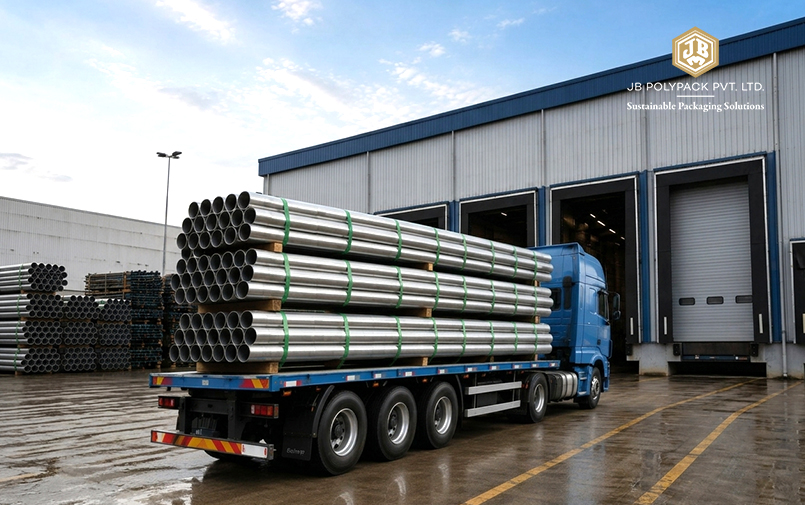
Palletised construction materials, compressed fibre bales, solar module stacks, appliance pallets, timber bundles, and paper reels fall into different application categories under the published ratio guidance. A single house specification applied across all of them will sit too high for some loads and too low for others.
Is PET strap for heavy loads always the highest grade available?
Load weight determines the break strength requirement. Grade, as the industry uses the term, determines the manufacturing tolerance suited to your application method. A heavy load on a manual line calls for high break strength in hand grade, and machine grade adds cost there without adding capability.
How should I compare quotes from different PET strap suppliers?
Ask each supplier for break strength against a stated width and gauge combination, elongation, grade, core size, and surface profile, and confirm whether figures are typical or minimum guaranteed values. Quotes stating width and price alone cannot be compared to one another.
If you are working from a strapping specification that was inherited rather than calculated, send us the load details and we will run through it with you.
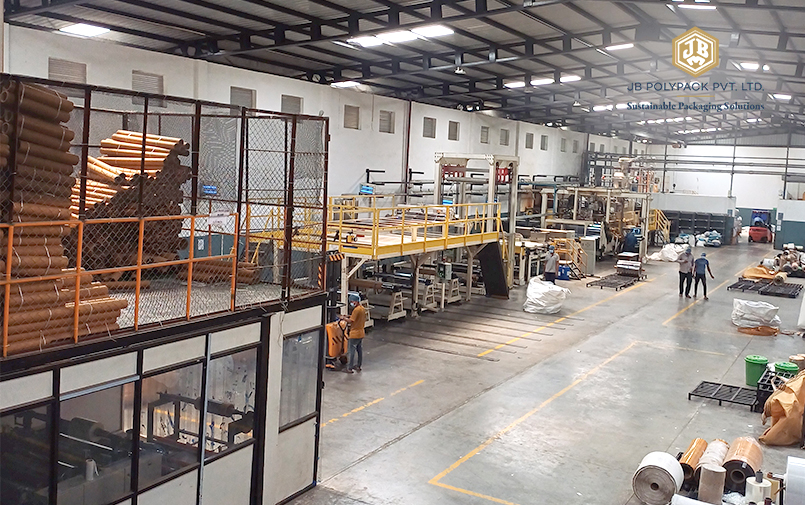
JB Polypack Pvt. Ltd. manufactures PET straps, rigid PET sheets, and thermoformed PET packaging from Surat as part of the Jay Bharat Group.