High-Tensile PET Straps: A Game Changer in Load Securing Straps
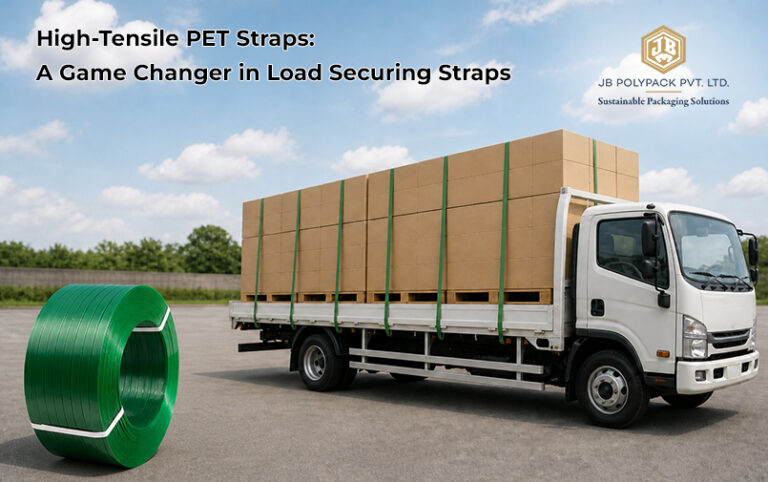
Most operations that switch from steel to load securing straps made from PET are not doing it because of a sustainability mandate. They are doing it because something went wrong: a transit damage claim, a warehouse injury from a strap release, or a cost audit that finally added up all the hidden expenses that steel strapping carries beyond the roll price.
The switch rarely happens because of a brochure. It happens because someone with a specific load problem ran the numbers and the numbers pointed to polyester PET strapping as the correct answer.
JB Polypack has manufactured PET strap from Surat since 1985, supplying construction, textile, solar, and refrigeration industries across India. What follows is drawn from that production and supply experience, not from generic packaging literature.
Why Load Securing Straps Fail: The Problem Steel and PP Cannot Fully Solve
A strapping band applied to a pallet or bundle performs two distinct functions. It holds the unitised load together during initial handling. It also absorbs shock energy during transit without releasing tension. These two requirements pull against each other.
A strap stiff enough to hold a rigid load firmly tends to snap under impact rather than absorb it. A strap with enough elongation to absorb shock tends to lose tension over time and allows load movement. No strapping material resolves both perfectly, but PET comes closer than the alternatives in most heavy-duty applications. And why it wins in the PET v Steel argument.
Steel strapping performs the holding function well and the shock absorption function poorly. Its elongation at break sits below 3%. When a load shifts or a vehicle crosses uneven road surface, steel either holds rigid or fractures. When it fractures under tension, the ends are sharp, energised, and dangerous to anyone in the vicinity.
PP strapping sits at the other extreme. Elongation at break can reach 20% to 25%, which sounds like a structural advantage until you consider that elongation under sustained load means the strap keeps stretching throughout a multi-day transit. What was correctly tensioned at dispatch may be loose enough to allow pallet shift by the time the load reaches its destination. PP also loses significant tensile strength when exposed to heat, which matters in covered vehicles during summer transport across western India where interior temperatures regularly exceed 60°C.
Polyester strapping solutions address both failure modes in a way neither steel nor PP can. PET elongation at break runs between 10% and 18% depending on grade and width, but the critical property is elastic recovery. After absorbing a shock load, PET returns close to its original length. This is the physical characteristic that makes PET strap the correct specification for heavy pallet securing where loads face vibration and impact during road or rail transport.
The Technical Case for High-Tensile PET Straps
The global PET strapping market consumed over 1.6 million metric tons in 2024, with packaging and logistics accounting for more than 72% of that volume. PET is the fastest-growing category within the broader strapping market. The PET Straps Market is expected to reach USD 3.6 billion and likely to surge at a CAGR of 5.9% during the forecast period from 2025 to 2035. That growth reflects buyers who have evaluated industrial PET straps against alternatives on technical grounds and made a deliberate switch.
Here is what that technical comparison looks like in practice:
Tensile strength by width. A 19mm PET strap at 0.8mm thickness delivers breaking loads in the range of 850kg to 1,100kg depending on grade. A 19mm steel strap of comparable width delivers a similar breaking load at approximately 2.5 times the weight per metre. For a pallet requiring six strap passes, the weight saving in strapping material alone is measurable in freight cost at volume.
Elongation and recovery. PET elongation at break is 10% to 18%. Elastic recovery after load release exceeds 90% for quality extruded PET strap. The strap reacts to shock by stretching and recovering rather than transmitting full force to the load or fracturing.
Temperature performance. PET retains tensile strength across a range from -40°C to approximately 80°C. For loads transported in refrigerated containers or through temperature extremes in open logistics chains, this stability matters. PP begins to soften and lose strength above 60°C, which is routinely exceeded inside covered trucks during Indian summer months.
Corrosion resistance. Steel rusts. This is an elementary fact, but it has real consequences for loads stored in open yards, coastal warehouses, or high-humidity cold stores. Rusted steel straps are weakened, and their ends become unpredictably sharp. PET is entirely unaffected by moisture, sea air, or humidity variations.
Safety in handling. Steel strap ends under tension behave like blades when they release. Warehouse injuries from steel strap release are documented and generate insurance and liability costs in operations that track them. Heavy-duty PET straps release tension without producing sharp edges, eliminating the laceration risk entirely.
PET Strap, Steel Strap, and PP Strap: How They Actually Compare
| Property | PET Strap | Steel Strap | PP Strap |
| Tensile strength (19mm) | 850–1,100 kg | 850–1,100 kg | 300–500 kg |
| Elongation at break | 10–18% | <3% | 20–25% |
| Elastic recovery | >90% | Low | Low |
| Weight per metre | ~0.9 kg/100m | ~2.3 kg/100m | ~0.7 kg/100m |
| Corrosion resistance | Excellent | Poor | Excellent |
| Safe to handle | Yes | No (sharp edges) | Yes |
| Temperature range | -40°C to 80°C | -40°C to 500°C | Up to 60°C |
| Recyclable | Yes (rPET stream) | Yes (metal scrap) | Yes (limited) |
| Tool type required | Friction-weld / heat-seal | Crimping tool | Friction-weld |
| Relative cost per metre | Medium | High | Low |
Figures shown are based on general industry data and JB Polypack’s production experience. Actual values vary by strap grade, width, gauge, and manufacturer specifications. Always verify with your supplier before finalising load security calculations.
When Steel Strap Remains the Correct Choice
PET strap is the right specification for most load securing applications, but there are three situations where steel remains the only safe option.
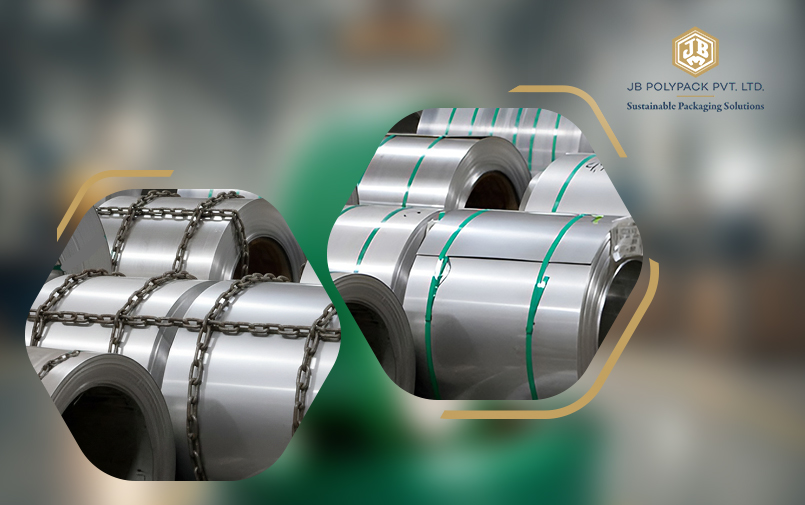
Loads with sharp edges that contact the strap directly. Metal billets, steel coils, angle iron, and similar materials have edges that can cut through PET under sustained tension. Steel strap is not damaged by contact with these surfaces. If your load has exposed sharp edges at the strap contact point, use steel or place edge protectors before applying PET.
Sustained temperatures above 80°C. PET begins to soften above this threshold. For loads that will sit in kilns, furnaces, or high-temperature processing environments while strapped, steel is the only appropriate material.
Zero-stretch rigidity requirements. Certain precision cargo, particularly calibrated machinery or rigid assemblies that cannot shift even fractionally during transit, requires a strap with near-zero elongation. PET’s elastic recovery, while an advantage for most loads, means there is minimal movement under load. For applications where even 2mm of movement is unacceptable, steel or composite strap is the specification.
For every other application, the technical and commercial case for PET is strong.
Where Plastic Strapping for Pallets Outperforms Steel: Industry by Industry
Broad claims about one material being superior to another are useful only when grounded in specific load conditions. The following breakdowns reflect actual application parameters across the industries JB Polypack supplies.
Construction Materials: Bricks, Tiles, Pipes, and Timber
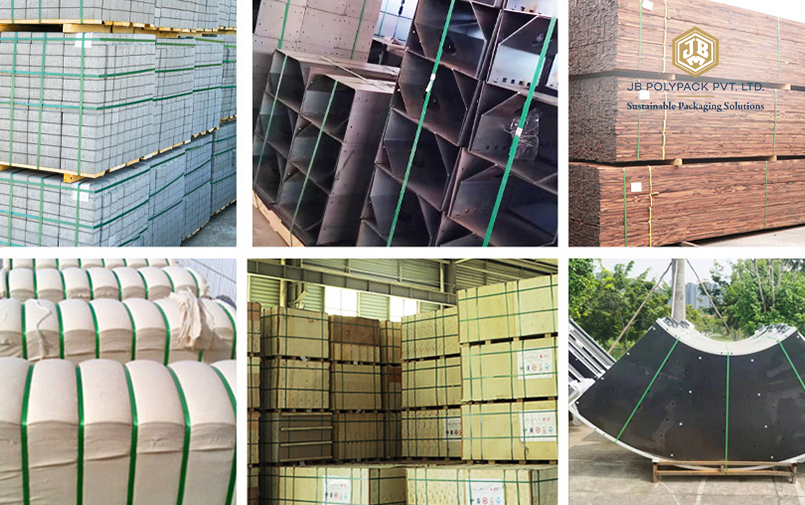
Construction is one of the highest-volume applications for plastic strapping for pallets in India. Brick manufacturers, tile producers, and pipe extruders all ship palletised or bundled loads of high dead weight across road networks that are frequently uneven.
The specific advantage of PET strapping for load securing in construction is the combination of high break load and shock absorption. A pallet of 500 bricks at approximately 1,200kg requires strapping that holds the static load and absorbs dynamic forces when the truck hits a pothole at speed. PET handles both. Steel holds the static load but transmits road shock directly to the pallet structure and the product, contributing to edge chipping and corner damage on premium tile finishes.
Timber bundling is a second construction application where PET outperforms steel. Timber expands and contracts with moisture content changes during transit, particularly on open flatbed vehicles. Steel strapping applied to green timber at the mill can be dangerously taut or slack by the time the load reaches site. PET’s elastic recovery accommodates the dimensional change in the bundle while maintaining appropriate tension throughout the journey.
Textile and Fiber Bale Compression
Fiber bales, whether cotton, synthetic, or recycled material, are compressed under significant pressure and then strapped to hold that compression from mill to processing facility. The strap must maintain sustained tension over days or weeks.
Steel holds compression well initially but is susceptible to fatigue under sustained cyclic stress when a fiber bale breathes slightly with temperature and humidity changes. PET’s elastic recovery and resistance to stress relaxation make it technically superior for this application. Several major fiber manufacturers in Gujarat have shifted from steel to PET strapping for bale compression because strap failure during transit or at the receiving mill carries real costs in both material and process terms.
Solar Panel Pallets and Renewable Energy Equipment
Solar panel logistics represent a growing and technically demanding application for industrial PET straps. Glass-fronted solar panels are fragile, expensive, and vulnerable to edge stress. They are typically palletised in stacks of 20 to 30 panels with foam interleaving before shipping to installation sites.
Steel strapping applied to solar panel pallets creates a point stress problem. High-tension steel straps can create localised pressure on the panel frame or glass edge. PET straps distribute load more evenly and absorb shock without transmitting full force, reducing the risk of edge delamination and glass micro-fracture during transit.
The outdoor storage factor matters here as well. Solar panels are frequently stored in yards before installation, sometimes for weeks. Strap corrosion in humid or coastal environments is a known failure mode with steel. PET eliminates it.
Refrigerator and White Goods Pallets
Appliance logistics involves heavy pallet loads, multi-storey stacking in transit vehicles, and temperature variation between warehouse and vehicle interior. Heavy-duty PET straps are specified by white goods manufacturers and their contract logistics providers for refrigerator and washing machine pallets for three specific reasons.
Appliance surfaces are finished. Steel strap edges or corrosion marks on a painted panel create warranty and returns issues. PET straps, particularly smooth-faced PET, present no edge risk and leave no corrosion staining.
Stacking weight in multi-level transport requires strapping that holds vertical compression without allowing the top pallet to shift laterally. PET straps applied at correct tension hold the stack without the fatigue issues that appear in steel after extended vibration over long hauls.
How PET Strap Is Manufactured
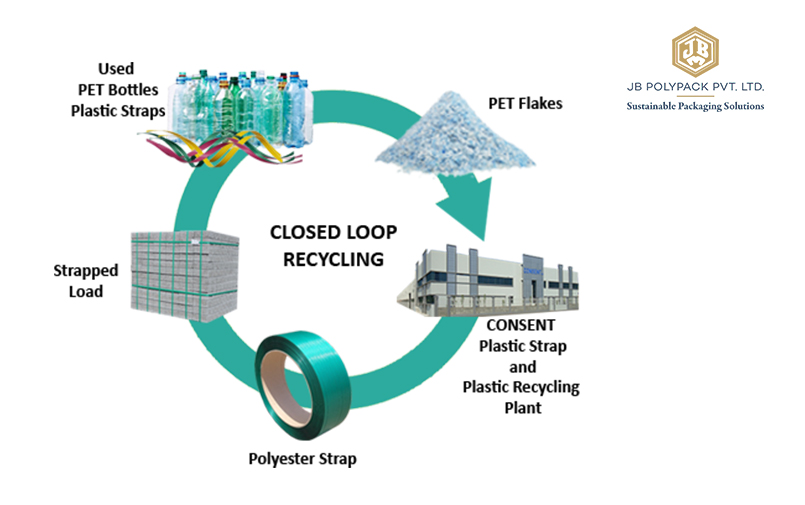
The PET strap manufacturing process starts as PET resin or, as in JB Polypack’s case, hot-washed recycled PET flakes sourced from post-consumer bottles and strap waste. The material is fed through a twin-screw extruder, melted, and drawn through a die at high speed. The stretching process during draw-down is what aligns the polymer chains and gives PET strap its high tensile strength and elastic recovery. A strap that has been under-drawn will have lower tensile strength and higher permanent elongation under load. A strap that has been over-drawn becomes brittle. The correct draw ratio, controlled by extrusion temperature and line speed, is what separates consistent industrial-grade strap from variable-quality output. After drawing, the strap is cooled, embossed or left smooth depending on specification, and wound onto cores.
This is why input material consistency matters. Recycled PET flakes from unsorted or poorly washed sources introduce contamination and viscosity variation that affects draw ratio consistency. JB Polypack sources food-grade sorted flakes, which gives predictable melt viscosity and consistent tensile output across production runs.
How to Specify a PET Strap Correctly
Buyers who specify PET strapping by width alone consistently encounter problems, because width is only one of four parameters that determine whether the strap performs correctly on the load.
Width and thickness together. Common widths run from 12mm to 32mm. Thickness ranges from 0.6mm to 1.2mm. Breaking load increases with both. A 19mm x 0.6mm strap has a substantially different break load than a 19mm x 1.0mm strap. Specify both dimensions, not width alone.
Embossed or smooth. Embossed polyester PET strapping has a textured surface that increases friction at the joint and performs better with friction-weld or heat-seal closure tools. Smooth strap is preferred for seal-and-crimp applications and for loads where surface contact marks must be minimised, such as finished appliances or glass. Embossed strap accounted for 67% of industrial PET strap consumption in 2024 and is the standard specification for most automated strapping line applications.
Core size. PET strap rolls are supplied on 200mm or 406mm cores. Core size determines compatibility with your strapping machinery. Confirm core size against your equipment specification before ordering, because this is the most common avoidable mismatch in first-time PET strap orders.
Break load calculation. Calculate load weight, number of strap passes, and apply a safety factor. The standard safety factor for transport strapping is 2:1 against the tension each strap will carry in service, meaning the break load specification per strap should be at least twice the working tension.
Virgin or recycled PET. JB Polypack manufactures PET strap from green hot-washed PET flakes and strap waste. Recycled-content PET strap meets the same tensile performance specifications as virgin PET strap for standard industrial applications. For export to markets with recycled content mandates, recycled-source PET strap documentation is a documented commercial advantage in procurement tendering.
The Total Cost Comparison Most Buyers Skip
Unit price comparisons between PET and steel strap are consistently misleading because they ignore five cost components that show up elsewhere in the operations budget.
Tool cost and maintenance. Steel strapping requires crimping tools that dull and require replacement or recalibration. Battery-powered PET friction-weld tools carry a higher initial purchase cost but a lower consumable cost per closure over the tool lifecycle. For high-volume operations running two or three shifts, this difference compounds significantly over twelve months.
Injury cost. Steel strap laceration injuries generate medical costs, lost time, and insurance premium adjustments. PET eliminates the laceration mechanism entirely. For operations that track total recordable incident rates, this is a quantifiable reduction in risk exposure, not an abstract safety benefit.
Freight weight. At equivalent break load, PET strap weighs significantly less per metre than steel. For operations where strapping weight contributes to freight calculation, particularly in container shipments charged by gross weight, the saving is calculable per load.
Disposal cost. Steel strap requires separation and metal recycling handling at the destination. PET strap goes into plastic recycling streams and is recoverable as rPET. In facilities or export destinations with plastic recycling infrastructure, disposal handling cost is lower and the material has recoverable value.
Transit damage rate. Steel’s low elongation under impact contributes to strap failure during transit, which results in load shift and product damage claims. PET’s elastic recovery reduces in-transit strap failure rates. The reduction in damage claims is load-specific but is the reason several Indian logistics operators categorise PET strapping as a supply chain cost reduction measure rather than purely a packaging materials line item.
Switching from Steel to PET: A Practical Checklist
Moving from steel to PET strapping is straightforward in most operations, but skipping any of the following steps creates avoidable problems.
Step 1 — Audit your current loads. List every load type you currently strap with steel. Note the weight, edge profile (sharp or smooth), temperature exposure, and number of strap passes. Loads with exposed sharp edges need edge protectors before PET can replace steel.
Step 2 — Calculate break load requirements. For each load, calculate the required break load per strap at a 2:1 safety factor against working tension. Match this to PET strap width and gauge specifications. Request a specification sheet from your supplier that maps break loads by width and gauge.
Step 3 — Check core size compatibility. Confirm the core size (200mm or 406mm) your existing machinery accepts. Ordering the wrong core size means the strap rolls do not fit your strapping heads.
Step 4 — Order friction-weld or heat-seal tooling. Steel crimping tools do not work with PET. Budget for friction-weld sealers, manual tensioners, and replacement wear plates. For semi-automatic or automatic lines, confirm PET compatibility with your machine manufacturer before ordering strap.
Step 5 — Run a trial on one load type before full switchover. Apply PET to your heaviest or most critical load first under controlled conditions. Check tension retention after 24 hours and after a short test transit. Verify the closure joint holds at the specified tension before rolling out across all lines.
Step 6 — Update your procurement specification. Document the width, gauge, core size, strap type (embossed or smooth), and break load for each load category. Share the specification with your supplier so repeat orders arrive to the same technical standard without re-specification each time.
What JB Polypack Supplies and to Whom
JB Polypack has manufactured PET straps from Surat since 1985 as part of the Jay Bharat Group. Our strap is produced from hot-washed green PET flakes and strap waste, processed through twin-screw extrusion to maintain consistent tensile output across production runs.
Our PET strap is produced from green hot-washed flakes sourced from post-consumer PET bottles. The recycled content is traceable through our procurement chain, and we can provide documentation for buyers whose customers or export markets require recycled-content certification. For operations supplying to EU markets under the Packaging and Packaging Waste Regulation that entered force in February 2025, recycled-source PET strap with documented chain of custody is a procurement advantage in tendering.
We supply PET straps in widths from 12mm to 32mm, in both embossed and smooth profiles, on 200mm and 406mm cores. Current customers include fiber bale manufacturers, construction material producers, solar panel logistics operators, and appliance manufacturers across India.
If you are evaluating a switch from steel or PP strapping, we supply sample rolls for tensile testing on your specific loads before a volume order is placed. Our team can advise on gauge, width, and closure method based on your load specifications and existing machinery.
Reach us at jbpolypack.com to request specifications, samples, or a volume quotation.
Frequently Asked Questions
Can PET strap be used with existing steel strapping tools?
Steel strapping tools use crimping mechanisms specific to steel and are not compatible with PET. PET strap requires friction-weld, heat-seal, or buckle-and-clip closure methods. Switching from steel to PET requires new tooling in most operations. Manual PET tensioners and friction-weld sealers are significantly lower in cost than battery-powered steel strapping tools, so the tooling investment typically pays back within a few months at moderate usage volumes.
What is the shelf life of PET strap in storage?
PET strap stored away from direct UV exposure at ambient temperature has a functional shelf life exceeding five years without tensile degradation. UV exposure over extended periods can cause surface embrittlement in non-UV-stabilised grades. JB Polypack supplies UV-stabilised PET strap for outdoor storage applications on request.
Is recycled-content PET strap as strong as virgin PET strap?
For standard industrial applications including pallet securing, fiber bale compression, and construction material bundling, recycled-content PET strap manufactured from quality-sorted, hot-washed flakes meets equivalent tensile specifications to virgin PET strap. The critical variable is input material quality and processing control, not whether the source is recycled or virgin.
What width and gauge is correct for a 1,500kg pallet?
A 1,500kg pallet typically requires 19mm to 25mm width strap at 0.8mm to 1.0mm gauge, with four to six strap passes depending on pallet configuration and transit conditions. The break load per strap should be specified at a minimum 2:1 safety factor against the per-strap load contribution. We calculate the correct specification for your load on request.
Does PET strap work in automated strapping machines?
PET strap is compatible with all major automated strapping machinery including Mosca, Fromm, and Strapack systems. Confirm core size and strap width compatibility with your machine specification before ordering. Embossed PET strap is the standard specification for automated line applications due to its friction performance at the sealing head.
JB Polypack Pvt. Ltd. is a Surat-based PET packaging manufacturer and part of the Jay Bharat Group. We supply PET straps, rigid PET sheets, and thermoformed PET packaging to industrial buyers across India and for export. Visit jbpolypack.com.